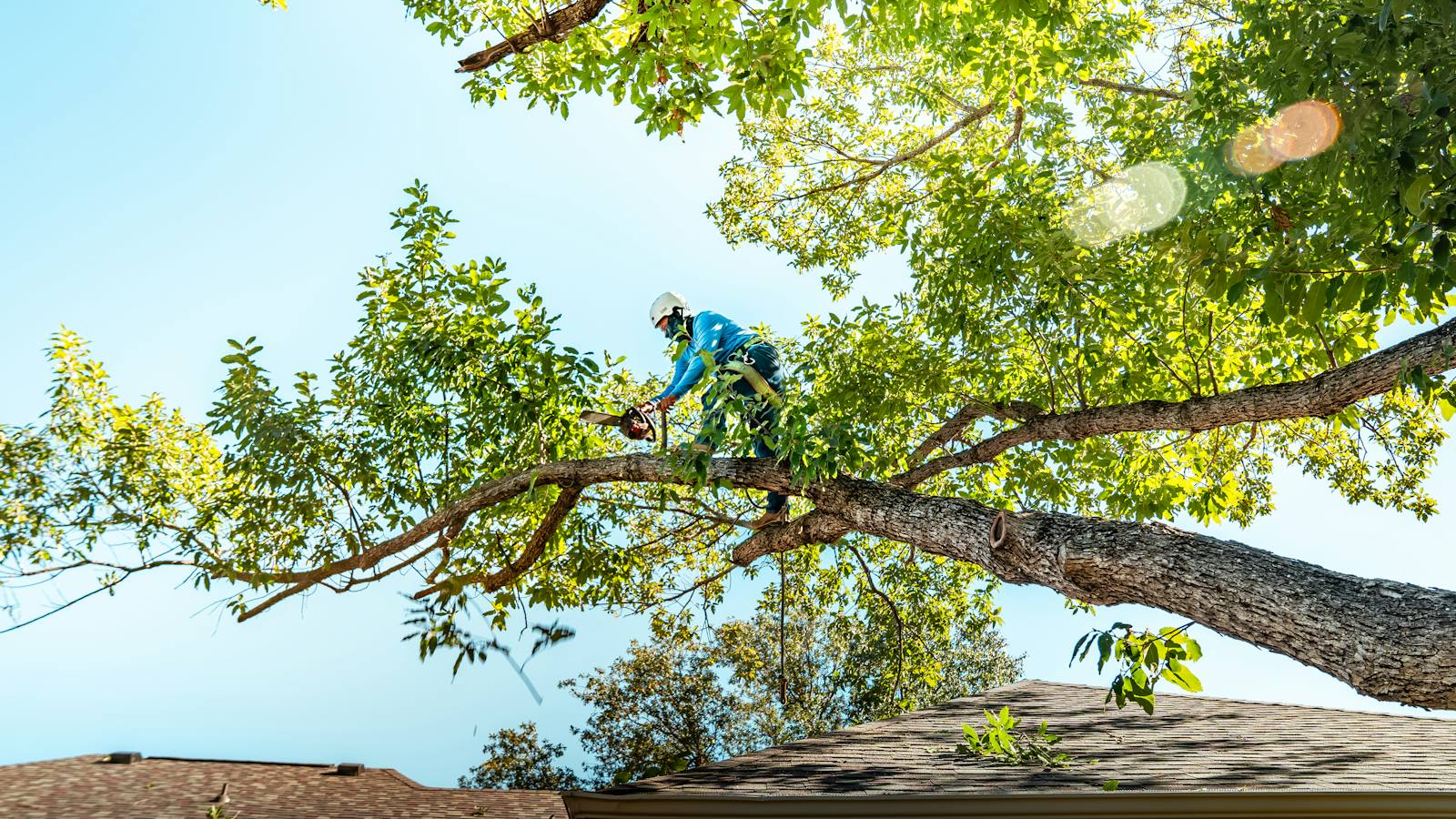
Most people pay between $385 and $1,070 to take down a single tree, and the national average is about $850. A small ornamental tree can cost under $300. A huge oak next to the house can reach $2,000, and emergency storm work can go well past that.
Tree height sets the base price, but the real bill depends on what is around the tree. A 40-foot maple in an open yard is a routine job. The same tree squeezed between a roof and a power line is not. The tables below show the ranges, and the sections after explain what pushes a quote up.
What drives the price
Height and trunk size. Taller trees need more rigging, more time and more disposal. Lawnlove prices removal at $9.50–$14.50 per foot. Thick trunks cost more even on a short tree, since there is more wood to cut and haul.
Access. A tree in an open back yard with a truck beside it is the cheapest case. A tree behind a fence, over a pool, or against a house usually means climbing and lowering sections by rope. LawnStarter says an inaccessible tree can raise the bill by up to 50 percent.
Condition. Dead and rotten trees are dangerous to climb. Crews charge more for them, and some will not climb at all and will use a lift or crane. A fallen tree is much cheaper: Lawnlove puts it at $90–$300 and LawnStarter at $85–$300.
Species. Dense hardwoods are slower to cut, and trees that grow multiple trunks take longer. Palms come out cheapest in Lawnlove's type table, at $310–$475.
Hazards. Power lines, structures and fences all add time and risk. If a tree touches a line, the utility company may need to handle it, and a regular tree service cannot touch it.
Tree removal prices at a glance
Removal cost by tree height
| Height | Lawnlove | This Old House |
|---|---|---|
| Up to 30 ft | $285–$435 | $150–$450 (30 ft or less) |
| 30–60 ft | $435–$870 | $450–$1,200 |
| 60–80 ft | $870–$1,160 | $800–$1,500 |
| Over 80 ft | $1,160–$2,000 | $1,000–$2,000 (80 ft or more) |
Removal cost by tree type (Lawnlove)
| Tree | Cost range |
|---|---|
| Palm | $310–$475 |
| Oak | $380–$1,160 |
| Pine | $475–$1,450 |
| Ash | $475–$1,160 |
| Maple | $570–$1,305 |
| Cedar | $570–$1,740 |
Stumps, cleanup and extras
| Service | Typical cost | Source |
|---|---|---|
| Stump grinding | $131–$438 (average $272) | LawnStarter |
| Stump removal (full) | $175–$516 (LawnStarter); $180–$525 (Lawnlove) | LawnStarter, Lawnlove |
| Hauling away debris | $100–$200 | Lawnlove |
| Wood chipping | $75–$125 per hour | Lawnlove |
| Log splitting | $75–$100 per tree | Lawnlove |
| Tree trimming (not removal) | $255–$655 (average $420) | Lawnlove |
| Emergency removal | $450–$3,000 | Lawnlove |
| Permit | $81–$438 | LawnStarter |
Do you need the stump ground out?
A standard tree removal quote usually covers cutting the tree down and hauling it away. The stump stays unless you pay extra, which surprises many people.
Stump grinding averages $272 per job at LawnStarter, with a range of $131–$438. Lawnlove lists a range of $180–$525 for stump removal. Per diameter inch the price is typically $2–$5, and many companies charge a minimum of about $100. If you have several stumps, ask for a multi-stump price. LawnStarter says the first stump runs about $123 and each additional one $37–$70.
Grinding leaves wood chips and roots below grade. Full removal digs out the stump and roots, which is a bigger job. For most yards, grinding is enough unless you are building over the spot. Hardwood stumps cost more, with a surcharge of $50–$150 per stump at LawnStarter.
DIY grinding is possible. LawnStarter lists grinder rental at $178–$364 per day and notes the job can take one to three days. For one small stump it can make sense. For a large one, hire it out.
Permits, rules and hidden costs
Many towns regulate tree removal, especially for large or protected trees. LawnStarter says most cities and counties require a permit, with some exceptions, and puts permit costs at $81–$438. Some places require you to plant a replacement. If the tree is on a property line or belongs to a neighbor, you need permission before removal.
Check these before you hire anyone:
- Local ordinance. Look up your city's tree rules or call the planning office. Fines for removing a protected tree can far exceed the cost of the work.
- HOA rules. Many associations require approval for front-yard trees.
- Utility lines. If a line runs through the canopy, the utility, not a tree service, may have to make the first cut.
- Travel fees. Lawnlove lists $50–$200 extra for travel over 30 minutes.
The cleanup line matters too. Hauling debris away runs $100–$200 at Lawnlove, and firewood splitting adds $75–$100 per tree. A quote that leaves out cleanup may leave a pile of logs and brush in your yard.
Emergency and storm work
When a tree is down on a house or a car, the price rises quickly. Lawnlove lists emergency removal at $450–$3,000, and This Old House says up to $5,000. Crews are in short supply after a storm, and cutting a tree off a roof is slower and riskier than a normal job.
Two things to know. First, homeowners insurance may pay if the tree fell because of a covered event such as a windstorm and damaged a covered structure. The coverage details depend on your policy, so call your insurer before you sign anything. Second, storm chasers show up after big events with trucks and low quotes. Check for a business address, proof of insurance and local references before you accept.
If a tree is leaning, cracked or dropping large limbs but has not yet failed, take it down on your schedule. Planned removal costs a fraction of an emergency call, which is a good argument for acting early.
Remove, trim or leave it?
Not every troublesome tree has to go. Lawnlove prices trimming at $255–$655 with a national average of $420, and LawnStarter has $315–$700. A healthy tree with a dead limb over the roof is a trimming job. A tree with a hollow trunk, a major crack or a lean toward the house is not.
Signs that a tree should come out include a dead crown, fungus growing at the base, large cracks in the trunk, roots lifting a slab or a foundation, and a lean that has changed after storms. If you are unsure, an ISA-certified arborist can assess it. The sources reviewed here do not list an assessment fee, so ask before you book.
On the other side, removing a healthy mature tree to avoid raking leaves is a poor trade. Shade lowers cooling costs and mature trees raise curb appeal. If you are removing one for a reason like a new addition, ask your city whether a replacement planting is required.
Can you do it yourself?
For a small tree on open ground, maybe. Lawnlove and LawnStarter both list professional removal of a tree under 30 feet at a few hundred dollars, and LawnStarter's DIY equipment list totals $425.50. That means the savings on a small job are small, once you count the saw, safety gear and disposal.
For anything near a house, a fence or a power line, do not try it. Falling trees are hard to control, and injuries from chainsaws and falls are common. Insurance rarely covers a homeowner's own mistakes, and a single bad cut can cost far more than the professional's fee.
A reasonable middle path is to hire a pro for the felling and do the cleanup yourself. Cutting up and hauling the wood and chipping the brush are the parts you can do safely, and Lawnlove lists hauling at $100–$200 and chipping at $75–$125 per hour, which you can trade for your own labor.
Signs it is time to call a pro now
Some trees can wait for the next quote cycle, and some cannot. A tree that is leaning after a storm, has a split trunk, or has large dead limbs over a house, driveway or play area is worth a call this week. The cost difference is real. Lawnlove lists a fallen tree at $90–$300 and emergency removal at $450–$3,000, so waiting for the tree to come down on its own can multiply the bill, before any damage repair.
On the other hand, an ordinary healthy tree that just annoys you can wait until you can get three quotes in a quiet season. Use the height table above to sanity-check each one. If a bid for a 40-foot tree comes in near $2,000 and your region is not especially expensive, ask what is included.
Whatever the tree, get the scope in writing: what comes down, what stays, what gets hauled, what the stump plan is and what happens if the crew damages your fence or lawn.
Hiring a tree service
Tree work is dangerous and an uninsured crew is a risk to you as well as to itself. Ask for proof of liability insurance and workers' compensation coverage, and call the insurer to confirm it is current. In many states a certified arborist, credentialed by the International Society of Arboriculture, is the person to ask when you need a judgment call on whether a tree has to come down or can be saved.
Get at least three written quotes. Each should state the job (full removal or sections), the stump, the cleanup, whether wood stays or goes, and the price. Treat a bid far below the others with suspicion. The cheapest bidder often lacks insurance, and a damaged roof or fence after a bad drop can cost far more than the saving.
Watch out for anyone who wants to "top" a tree to reduce its height. It harms the tree and rarely solves the problem. A proper trim, at $255–$655 according to Lawnlove, may keep a healthy tree that otherwise would need to come out.
Sample estimate
Illustration
Sample estimate: one 50-foot oak in a suburban backyard, with stump and cleanup
- Removal of a 50-foot oak (inside Lawnlove's $435–$870 band for 30–60 ft)
- $800
- Stump grinding
- $300
- Debris hauling
- $150
- Wood chipping, one hour
- $100
- Local tree permit
- $100
- Total
- $1,450
This is an illustration, not a quote. Each line sits inside the ranges quoted by Lawnlove (removal, hauling, chipping) and LawnStarter (permit, stump). A tree over a house or near power lines would cost more.
Ways to bring the price down
- Bundle several trees or stumps into one visit. LawnStarter says additional stumps after the first run $37–$70 each.
- Skip the stump grinding if you will not build on the spot. A stump can stay, rot and even serve as a planter.
- Keep the wood. Lawnlove lists log splitting at $75–$100 per tree, and you can handle hauling and splitting yourself.
- Remove a dying tree on a normal day. Emergency calls run $450–$3,000 at Lawnlove, against a few hundred dollars for an ordinary small tree.
- Ask each company about its slow season. Crews are busiest after storms, and a planned job in a quiet stretch is easier to negotiate.
- Prune instead of removing when the tree is healthy. Trimming averages $420 at Lawnlove.
Frequently asked questions
How much does it cost to remove a large tree?
A tree over 80 feet runs about $1,160–$2,000 at Lawnlove and $1,000–$2,000 at This Old House. A hazardous large tree near a house or power lines can cost more, since it may need a crane.
How much does tree removal cost per foot?
Lawnlove gives $9.50–$14.50 per foot of height and LawnStarter $10–$14. That works for a rough check, but access and condition can move the price a lot.
Does tree removal include stump removal?
Usually not. Stump grinding is typically billed separately, with LawnStarter listing an average of $272 per job and Lawnlove $180–$525 for stump removal. Ask for the stump as its own line in the quote.
Does homeowners insurance cover tree removal?
It may, if the tree fell because of a covered event such as a windstorm and damaged a covered structure, per This Old House. A tree that falls without damaging anything, or that is removed for convenience, usually is not covered. Check your own policy.
Do I need a permit to remove a tree?
Often. LawnStarter says most cities and counties require one, with some exceptions, and lists permit costs at $81–$438. Protected and heritage trees have stricter rules, so call your city before you hire anyone.
How much does emergency tree removal cost?
Lawnlove puts emergency work at $450–$3,000, and This Old House says up to $5,000. A tree on a roof or blocking access will land near the top.
What is the cheapest time of year to remove a tree?
The sources reviewed here do not give seasonal pricing. Many tree services are busiest after storms and in spring and fall, so ask about their slow season. Planned jobs always cost less than emergency ones.
Sources
We compare several independent sources for every guide and say where they disagree. Pages were last checked on the dates shown.
- How Much Does Tree Removal Cost in 2026? (opens in a new tab), Lawnlove. Accessed November 22, 2026. Used for: average and range, cost by height and type, emergency, add-ons, trimming
- How Much Does Stump Grinding Cost in 2026? (opens in a new tab), LawnStarter. Accessed November 22, 2026. Used for: stump grinding cost, per-inch rate, multi-stump pricing, rental, permits
- How Much Does Tree Removal Cost? (opens in a new tab), LawnStarter. Accessed November 22, 2026. Used for: average and range, per-foot rate, fallen tree, inaccessible trees, permits
- Tree Removal Cost (opens in a new tab), This Old House. Accessed November 22, 2026. Used for: average, cost by height and type, emergency cost, insurance note
How we put this guide together
We don't take money from contractors or sell your details. Ranges come from published national price data, wage statistics and installer price lists, cross-checked and rounded. Read how we price or tell us if a number looks off in your area via our contact page.
Related cost guides
Fence installation
Typical total for roughly 100 to 200 linear feet of wood fence, installed
$2,000–$7,000Driveway
Typical installed cost of a new driveway, national average and range (Fixr, mixed materials)
$3,200–$10,000Deck
Typical professionally built deck, national range (Lawnlove)
$3,920–$10,540Roof repair
Typical total for a single roof repair, such as a leak, flashing or a patch of shingles
$400–$1,900