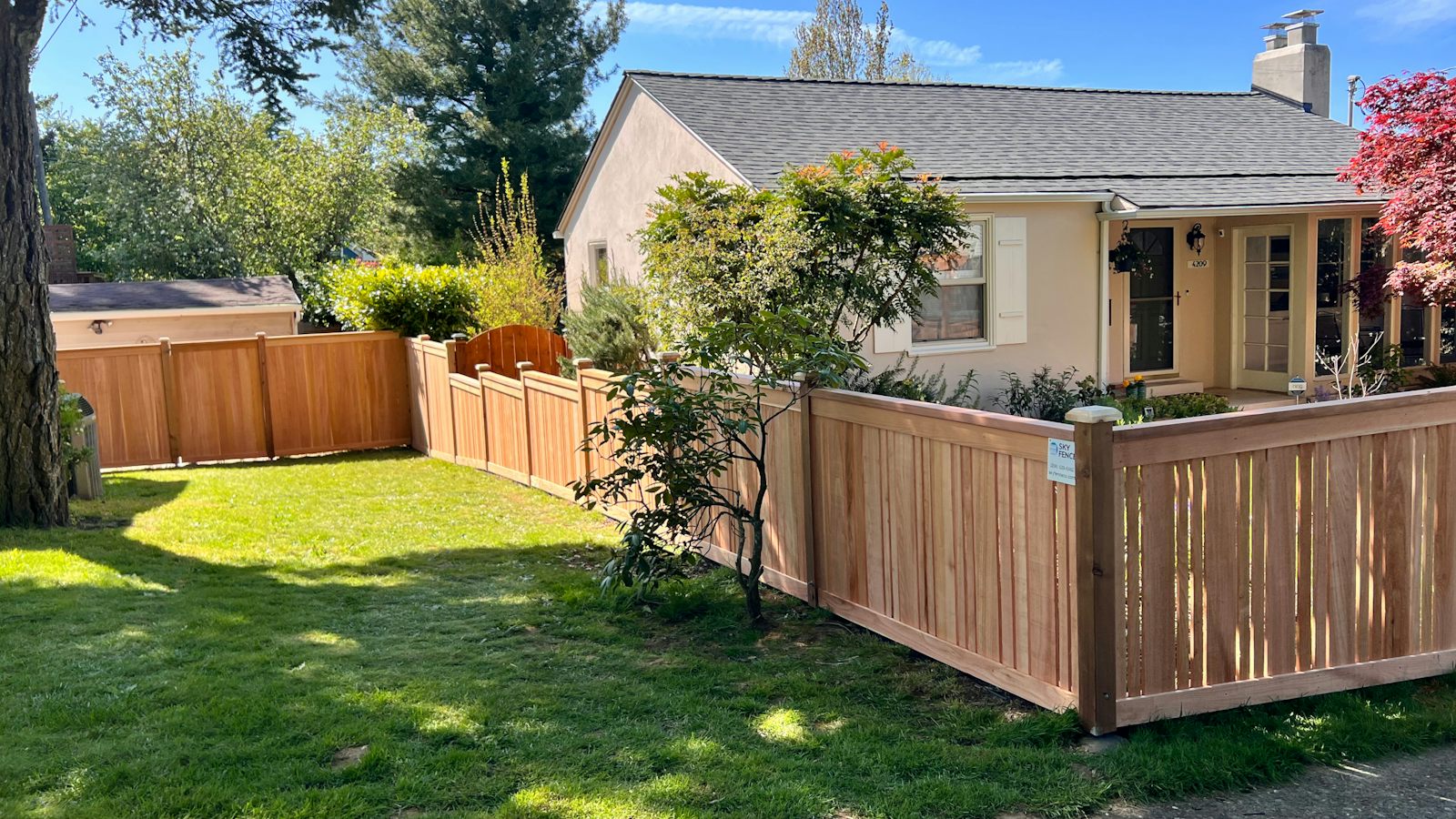
Most homeowners spend between $2,000 and $7,000 to install a fence, and the national averages the big cost sites publish land between $3,200 and $4,500. Per foot, a basic wood fence costs about $15–$35 installed, chain link starts near $10 and metal or vinyl climbs from there.
The spread is wide because "a fence" means a dozen different jobs. Four feet of galvanized chain link around a yard is a different purchase than 180 feet of six-foot cedar privacy panels on a sloped lot. The sections below break out what moves the number, so you can price your own yard instead of trusting a single headline average.
What drives the price
Length is the obvious one, but it is not the only multiplier. Four things decide most quotes.
- Material. Wood sits in the middle of the pack. Chain link is cheaper, while vinyl, aluminum, steel and wrought iron are progressively more expensive. Inside "wood" there is another gap: 247Pro lists pressure-treated pine at $20–$30 per foot installed, cedar at $25–$45 and redwood at $30–$50.
- Height. A 6-foot privacy fence uses more board, longer posts and deeper holes than a 4-foot picket fence. Inch Calculator notes that anything over 6 feet costs significantly more because the structure has to be beefed up, and taller fences are more likely to need a permit and inspection.
- Terrain. Rock, roots and slopes slow the crew. Setting posts in rocky soil or stepping panels down a hill adds hours, and hours are what you pay for.
- Gates and corners. Every corner, gate and change of direction adds posts and fiddly work. A rectangle with one gate prices far better than a winding line with four.
Post holes deserve their own mention. Fixr breaks out post installation at $40–$150 per post. A long run needs a lot of posts, so that line adds up fast if your site is tough.
Fence installation prices at a glance
Installed cost per linear foot by material
| Material | Fixr (installed) | 247Pro (installed) | Typical lifespan (247Pro) |
|---|---|---|---|
| Chain link | $12.25–$40 (see note) | $10–$40 | 15–20 years |
| Wood | $15–$35 | $20–$50 | 10–15 years |
| Vinyl | $15–$40 | $25–$60 | 20–30 years |
| Aluminum | $15–$40 | $30–$80 | 30+ years |
| Steel | $15–$60 | $25–$80 | Not stated |
| Wrought iron | $22–$40 | $35–$100 | 40+ years |
Cost by height and style (Inch Calculator)
| Style | Cost per linear foot |
|---|---|
| Chain link (4, 5 or 6 ft) | $5–$15 |
| 4-ft wood picket | $10–$36 |
| 6-ft wood privacy | $13–$45 (about $25 on average) |
| 4-ft vinyl picket | $15–$35 |
| 6-ft vinyl privacy | $30–$55 |
| Aluminum | $20–$55 |
Gates, removal and permits
| Item | Typical cost | Source |
|---|---|---|
| Walk gate, 48 in., installed | $400–$800 | Inch Calculator |
| Gate with installation (general) | $50–$400 | Fixr |
| Driveway gate, installed | $1,000–$6,000 | Fixr |
| Old fence removal and disposal | $350–$600 (100 ft) | Inch Calculator |
| Old fence removal and disposal | $600–$800 (100–200 ft) | Fixr |
| Permit | $30–$200 | Inch Calculator |
Labor is a big slice, but you can see it coming
Fixr puts labor at $5–$20 per linear foot for most fence types, and $10–$20 for wood. 247Pro says labor is usually 30 to 50 percent of the total project cost. Inch Calculator quotes $50–$70 per hour per builder, which is a useful sanity check if a contractor gives you an hourly number.
It helps to know what a crew does in a day. A two-person team can often set the posts and hang the panels on a typical backyard in a day or two, but concrete needs time to cure and rain delays it. If someone quotes you a flat price that looks too good, ask whether it includes digging, concrete, hardware, disposal of spoil dirt and cleanup.
One tip: the labor line barely changes between a pine fence and a cedar fence, since the work is almost identical. The material gap is where the money is, so compare materials before you compare crews.
DIY or hire it out?
Doing it yourself saves the labor, which is roughly a third to a half of the total. The catch is the work itself. Digging dozens of post holes by hand is brutal, and a rented auger and tools add up. 247Pro estimates tool rental at $100–$400 and notes that DIY materials cost the same as a pro's.
The cases where DIY makes sense are short, flat runs with a simple style, such as 60 feet of 4-foot picket or a chain-link enclosure. A 150-foot privacy fence on a slope is a different story. Crooked posts and uneven panels are obvious from the street and tend to get worse as the wood moves.
If you do hire out, ask to see photographs of a fence the crew built at least a year ago. Fresh work always looks straight. Sagging gates and leaning posts show up after a season or two.
Permits, property lines and hidden costs
Permits are cheap compared with the fence. Inch Calculator says they typically run $30–$200, and Fixr notes they are not often required but vary by location. Height limits, setbacks from the sidewalk and rules for front yards are the usual triggers. Homeowners associations add another layer, and an HOA can reject a fence your city would happily approve, so check before you sign.
The costs that surprise people are different:
- Survey. If you are not sure where the property line runs, a survey is cheaper than rebuilding a fence that sits on the neighbor's land. The sources reviewed here do not give a survey price, so get a local quote.
- Removal. Tearing out and hauling away an old fence adds $350–$800 depending on length and source.
- Utilities. Call 811 before anyone digs. Crews normally handle this, but confirm it.
- Staining or sealing. Wood fences usually need a coat of stain or sealer within a year or so. This is not in most quotes.
Wood also lasts the shortest time of the common options. 247Pro lists 10 to 15 years for wood against 20 to 30 for vinyl and 30 or more for aluminum, which is why the cheaper fence is not always the cheaper fence over a decade.
Choosing a material for your yard
For most backyards the real choice is among four options.
Pressure-treated wood privacy fence. The default. Cheapest way to get real privacy, and easy to repair a board at a time. Plan on restaining and a shorter life.
Cedar. Costs more upfront and resists rot better. Worth it if you want the look and will keep it sealed. If you plan to paint, treated pine is usually fine.
Vinyl. Higher price, almost no maintenance. It does not take paint well and can crack in hard cold, so it is a better fit for a stable climate than for a yard with big temperature swings.
Aluminum or steel. Good for pools, front yards and keeping dogs in, but not for privacy. Prices climb quickly, and these are the options where a cheap-looking quote may mean thin material.
Chain link is the right answer for a lot of jobs. It is not pretty, but at roughly $10–$15 per foot at the low end it is the cheapest way to enclose a large area. Vinyl-coated mesh looks better and costs more.
Where you live changes the number
National averages blur real regional differences. 247Pro's California figures show how much: wood at $24–$47 per foot, vinyl at $30–$65 and metal at $35–$110, with labor 15 to 25 percent above the national average. It puts Los Angeles and San Diego another 10 to 20 percent above state averages and says California as a whole runs 10 to 25 percent above national.
That pattern holds in most high-cost metro areas. Labor is the piece that moves, because material prices are fairly uniform once freight is counted. A cedar board costs about the same in a small town as in a big city, but the crew hour does not.
If you live in an expensive metro, expect to land in the upper half of the ranges in the tables above. If you live somewhere with low wages and soft soil, the lower half is realistic. Either way, local quotes beat any national table, so use these numbers to judge whether a bid is in the right neighborhood, not to predict it to the dollar.
Repair, replace or stain: when a full new fence is not needed
Many fences get replaced when a repair would do. If the posts are sound and the panels are the problem, replacing a few boards or panels costs a small share of a new build. Posts are the key. A leaning fence with rotted post bases usually means the whole section is near the end of its life, and patching it only buys a season or two.
Wood fences last about 10 to 15 years according to 247Pro. If yours is at year eight and the posts are solid, a coat of stain or sealer is much cheaper than replacing it and can add years. If yours is at year fifteen and the boards are soft, new fence is the better use of money.
A partial replacement can also make sense when a neighbor's tree or a storm took out one side. Ask the contractor to quote the damaged section separately, and to say whether the new wood will match the weathered old wood. It often will not for the first year.
Timing, delays and what to expect on the day
Most residential fences go up in a day or two once the crew arrives, but the calendar around that is slower. Utility marking, permit approval and material lead times can add days or weeks, and wet weather delays digging and concrete. Ask for a start window and for the contractor to tell you if the date slips.
On install day, mark your property line if you know it, move cars and garden items away from the fence path, and tell your neighbors. Crews often need to access the neighbor's side briefly for the last few boards, so a heads-up avoids friction.
After the job, walk the whole fence with the crew lead. Check that gates swing freely, posts are plumb, boards are fastened evenly and all debris is gone. Take photos before you pay the balance. Any warranty on workmanship should be in writing and name what it covers.
How to compare quotes
Get at least three quotes and make them comparable. Ask each contractor to write down the height, the post size and spacing, the number of gates, the type of wood or vinyl, the concrete or gravel used on the posts, the removal plan and who pulls the permit.
Red flags are the usual ones. A very low price with no written scope, a large deposit before any work, no proof of insurance, and a crew that will not say who the actual installer will be. Ask what the deposit covers and when the balance is due.
Watch the per-foot number against the ranges in the tables above. If a 6-foot wood fence comes back well under the $13 low end Inch Calculator lists, the contractor is cutting something out, and if it lands far above $45, ask what the premium covers. Neither is automatically wrong, but you should know why.
Sample estimate
Illustration
Sample estimate: 150 ft of 6-foot wood privacy fence, one walk gate, old fence removed
- 6-ft wood privacy fence, 150 linear ft at $25 per ft installed
- $3,750
- Walk gate, 48 in., installed
- $600
- Removal and disposal of the old fence
- $450
- Permit
- $100
- Total
- $4,900
This is an illustration, not a quote. It uses the $25 per foot average Inch Calculator gives for 6-foot wood privacy fence and mid-range figures from its gate, removal and permit ranges. Rocky soil, slopes or an HOA requirement for premium materials would raise it.
Ways to bring the price down
- Get quotes in the slow season. Late fall and winter are slower for fence crews in many regions, and some will discount to keep the crew busy.
- Keep the line straight and the corners few. Every corner and gate adds posts and labor.
- Use treated pine instead of cedar if you plan to stain or paint anyway. 247Pro lists pine at $20–$30 per foot installed against $25–$45 for cedar.
- Pull out the old fence yourself if it is wood and in manageable sections. Removal and disposal run $350–$800 when a crew does it.
- Choose a 4-foot or 5-foot height for areas where you do not need full privacy. You save on both board and post depth.
- Share the fence with a neighbor if it sits on the line and they want it too. Agree on the cost in writing before the work starts.
Frequently asked questions
How much does it cost to put up 200 feet of fence?
At Fixr's national average, a 200-foot run of 4-foot cedar picket with a gate costs about $4,500, with a typical range of $3,000–$7,000. At $15–$35 per foot for wood, 200 feet works out to $3,000–$7,000, which matches. Vinyl or aluminum would push it higher.
What is the cheapest type of fence to install?
Chain link. Inch Calculator lists it at $5–$15 per foot, and 247Pro at $10–$40. Barbed wire is cheaper still, but it is for livestock and rural property, not a residential yard.
Is a vinyl fence cheaper than wood in the long run?
Often it is closer than the sticker price suggests. 247Pro lists vinyl at $25–$60 per foot with a 20 to 30 year life and wood at $20–$50 with 10 to 15 years. Wood also needs periodic staining, so the gap narrows over time.
Do I need a permit to build a fence?
Often yes, but not everywhere. Inch Calculator says permits typically cost $30–$200, and Fixr says they are not often required but vary by location. Height limits, setbacks and HOA rules decide it, so call your building department before you order materials.
How much does a fence gate cost?
A basic installed walk gate runs about $400–$800 at Inch Calculator. Driveway or security gates are in a different class, at $1,000–$6,000 at Fixr and up to $12,000 for large custom ones at Inch Calculator.
How much does it cost to remove an old fence?
Inch Calculator puts removal and disposal at $350–$600. Fixr gives $600–$800 for most fences of 100–200 linear feet. Doing the teardown yourself saves most of that if the old fence comes apart easily.
How tall can a fence be?
It depends on your city and neighborhood. Many places cap backyard fences at around 6 feet and set lower limits for front yards, but those rules are local. Inch Calculator notes that taller fences are more likely to need a permit and inspection.
Sources
We compare several independent sources for every guide and say where they disagree. Pages were last checked on the dates shown.
- Cost to Install a Fence – 2026 Average Prices (opens in a new tab), Inch Calculator. Accessed November 22, 2026. Used for: per-foot ranges by height and style, gates, removal, permits, labor rates
- Fence Installation Cost (opens in a new tab), Fixr. Accessed November 22, 2026. Used for: national average, range by material, labor, gates, removal
- Cost to Build a Fence: Wood vs Vinyl vs Metal (opens in a new tab), 247Pro. Accessed November 22, 2026. Used for: range by material, lifespan, labor share, DIY tool rental
How we put this guide together
We don't take money from contractors or sell your details. Ranges come from published national price data, wage statistics and installer price lists, cross-checked and rounded. Read how we price or tell us if a number looks off in your area via our contact page.
Related cost guides
Gutter installation
Typical total to install new seamless gutters on a whole house, aluminum or vinyl
$1,400–$3,000Deck
Typical professionally built deck, national range (Lawnlove)
$3,920–$10,540Driveway
Typical installed cost of a new driveway, national average and range (Fixr, mixed materials)
$3,200–$10,000Tree removal
Typical cost to remove one tree, national range and average (Lawnlove, LawnStarter)
$385–$1,070