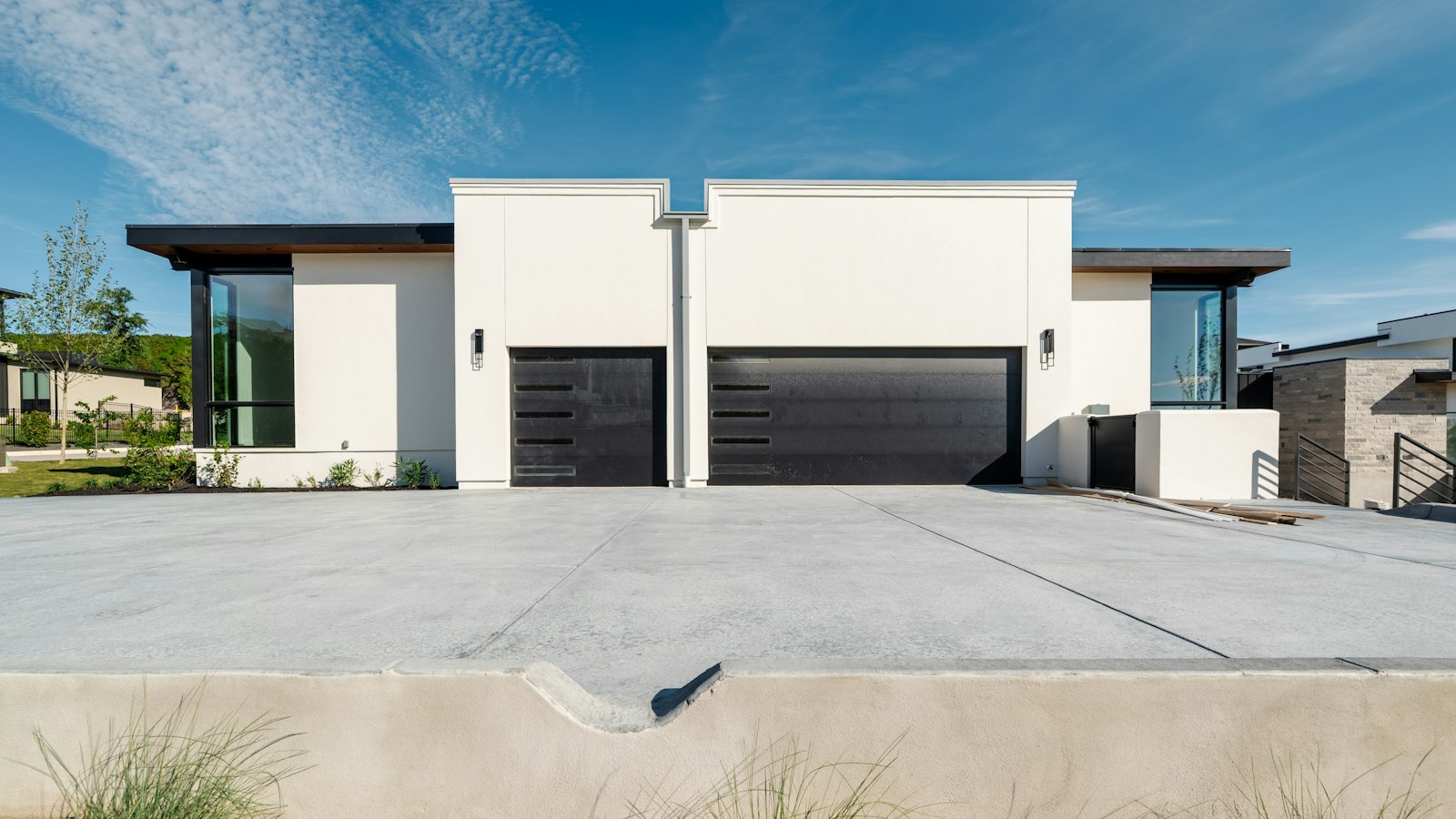
A new driveway costs about $6,960 on average, and most projects fall between $3,200 and $10,000, according to Fixr's national figures. That works out to roughly $8–$25 per square foot with labor, but the material you pick decides which end of that range you land on.
Gravel is cheapest, asphalt is the budget paved option, concrete costs more and lasts longer, and pavers sit at the top. The sources below disagree by a lot, partly because some quote materials only and some quote the finished job. The tables mark which is which, so you are not comparing a bag of gravel to a finished stamped driveway.
What drives the price
Size. Total cost scales with square footage. A two-car, 20 x 20 ft pad is 400 square feet, while a long driveway to a house set back from the road can be many times that. Per-foot prices drop a little with scale, but not as much as people hope.
Material. This is the biggest swing. At Fixr's materials-only prices, gravel is $1–$3 per sq ft and paving stone reaches $7–$30.
Site prep. Fixr lists grading at $4–$8 per sq ft and excavation at $1–$5. Those numbers matter on a slope or soft ground, where the base has to be built up before any surface goes down. The same source says a driveway base is typically 4 to 7 inches thick, for a total thickness of 8 to 12 inches with the surface.
Labor. Fixr says labor is $5–$15 per sq ft, up to $30 for rare stone or unusual finishes, and runs about 50 to 60 percent of project cost. LawnStarter puts labor on a concrete driveway at about 50 percent.
Thickness. A thicker slab holds heavy vehicles better but costs more. LawnStarter says 2 additional inches raise the cost about 25 percent.
Driveway prices at a glance
Cost per square foot by material
| Material | Materials only (Fixr) | Installed (other sources) | Lifespan (Fixr) |
|---|---|---|---|
| Gravel | $1–$3 | Not stated | 20–100 years |
| Asphalt | $1–$5 | $7–$13 (Inch Calculator) | 12–25 years |
| Concrete | $4–$7 | $6–$16 (LawnStarter) | 20–40 years |
| Stamped concrete | Not stated | $10–$16 (Inch Calculator) | Not stated |
| Exposed aggregate | $3–$7 | Not stated | 15–40 years |
| Concrete pavers | $7–$13 | $10–$20 (Inch Calculator) | 25–100 years (pavers) |
| Brick pavers | $1–$25 | $20–$30 (Inch Calculator) | 25–100 years (pavers) |
Total cost by driveway size (Fixr, labor included)
| Size | Dimensions | Total cost |
|---|---|---|
| Single stall | 10 x 20 ft | $1,600–$5,000 |
| Single | 12 x 24 ft | $2,300–$7,200 |
| Double stall | 20 x 20 ft | $3,200–$10,000 |
| Double | 24 x 24 ft | $4,610–$14,400 |
| Triple | 24 x 36 ft | $6,910–$21,600 |
Concrete finishes (LawnStarter)
| Finish | Cost per sq ft |
|---|---|
| Standard gray | $4–$6 |
| Stained | $6–$12 |
| Stamped | $8–$15 |
Which surface is right for you?
Gravel is the cheapest by far and works well for long rural driveways. It needs regrading and topping up, it can wash out in heavy rain, and it is a hassle to shovel. Fixr lists a lifespan of 20 years or more with upkeep.
Asphalt is the usual budget choice for a paved driveway, and it is a good fit in colder climates because it tolerates freeze and thaw cycles and is easy to patch. The tradeoff is a shorter life. Fixr lists asphalt at 12 to 25 years and recommends sealcoating, at $0.68–$2.10 per sq ft.
Concrete costs more upfront. It lasts 20 to 40 years per Fixr, 20 to 35 per LawnStarter, and needs little upkeep. Stained or stamped finishes help it look better, but cost more. Cracks are the main complaint, and they can be minimized by proper base, jointing and curing.
Pavers are the most expensive and the most repairable. A section that sinks can be lifted and relaid, which is not true of poured concrete. If you want a high-end look and plan to stay, they are a solid choice. For resale value on a modest house, they are rarely worth the premium.
A realistic default for many homes is concrete for a two-car driveway you want to forget about, and asphalt if the budget is tight or you live where winters are hard on concrete.
Tear-out, hauling and hidden costs
Replacing a driveway adds a step many first-time buyers miss. Fixr says removing an old driveway adds $1–$4 per sq ft. LawnStarter quotes $1,500–$2,500 for concrete removal. For a typical 480 square foot driveway that is a four-figure line on its own.
Other costs that sit outside the headline price:
- Permit or license fee. Fixr lists $50–$600 depending on driveway length and city. LawnStarter adds that permits and taxes can total $500–$2,000 where required.
- Aprons where the driveway meets the street, $3–$10 per sq ft (Fixr). Many cities regulate these and may require their own contractor.
- Tree and stump removal in the path, $400–$1,100 and $200–$700 respectively (Fixr).
- Drainage. If the old driveway cracked because water pooled under it, a new surface on the same base will fail the same way. Fix the grading first.
- Heated driveway systems, $6–$10 per sq ft (Fixr), for snow country buyers who want them.
Ask each bidder whether grading, base and removal are in the price. Bids that leave them out look cheap and surprise you later.
Who does the work and what it costs per hour
Concrete finishing and paving are skilled trades, and the quality of the finish shows. Fixr cites hourly rates of $25–$60 for smaller jobs. The BLS publishes wages for cement masons and concrete finishers, but the occupation page was not available for this guide, so we are not quoting a wage here.
What you can control is the contractor's process. For concrete, ask about the base material and compaction, the reinforcement (rebar or wire mesh), the control joint spacing and the sealing plan. For asphalt, ask about the thickness of the compacted layer and the base. Those details decide whether the driveway looks good in year 10.
Small asphalt jobs are sometimes handled by crews who only work big accounts and treat residential work as a filler, so ask when the job will actually be scheduled and how it will be compacted.
Maintenance and what it costs over time
A driveway is not a one-time purchase if you want it to last. Asphalt is the most demanding. Fixr recommends sealcoating at $0.68–$2.10 per square foot with labor, which for a 480 sq ft driveway is a few hundred dollars each time. Cracks should be filled before water gets in and freezes.
Concrete asks for less, mostly sealing and clearing stains. LawnStarter notes that it has a lifespan of 20 to 35 years, and Fixr gives 20 to 40. The usual enemies are de-icing salts, heavy vehicles on thin slabs and tree roots. Cracks tend to appear in the first few years, and control joints give them somewhere to go.
Gravel needs regular regrading and topping up. Pavers need weeds kept out of the joints and occasional re-leveling. Fixr gives paver and gravel lifespans of 25 to 100 and 20 to 100 years, but the high end of those ranges assumes upkeep.
Over 20 years, a cheaper surface with regular care can cost as much as a more expensive one that is left alone. Ask each bidder what the maintenance plan looks like and what it will cost.
Climate, drainage and getting the base right
Most driveway failures come from the ground, not the surface. Water that collects under a slab or asphalt softens the base, and freeze and thaw cycles do the rest. Fixr says a base is typically 4 to 7 inches thick, bringing the total to 8 to 12 inches with the surface, and that grading runs $4–$8 per sq ft and excavation $1–$5. Those line items are not glamorous, but they are the reason one driveway outlasts another.
In cold regions, asphalt's ability to flex is a plus, while concrete needs well-placed joints and the right mix. In hot, dry regions concrete has the edge, since asphalt softens in the sun. In areas with heavy rain, drainage matters more than material: a driveway that slopes toward the house will cause problems regardless of the surface.
Before you hire anyone, walk the site after a heavy rain and look at where the water goes. If it pools on or beside the existing driveway, mention it to every bidder and ask how they will deal with it. A contractor who has no answer is telling you something.
DIY, patching and resurfacing
Gravel is the only driveway most homeowners can reasonably build themselves. Inch Calculator's example for a 16 x 40 ft driveway estimates about 22 tons of pea gravel at roughly $550–$770 in material, before equipment and base work. Concrete and asphalt are different. Both need equipment, timing and a crew, and mistakes are permanent.
If your driveway is cracked but stable, patching or resealing is cheaper than starting over. Fixr's figures for sealcoating asphalt, $0.68–$2.10 per sq ft, are a fraction of the $9–$29 per sq ft Fixr gives for full replacement. Large cracks, sunken sections and standing water point to a base problem that patching will not fix.
When you do replace, treat the work as two jobs: removal and base, then the surface. Quoting them separately makes it easier to see where the money goes and to compare bidders fairly.
How to compare bids and avoid problems
Get three written quotes that state the square footage, the thickness, the base depth, the material and finish, the removal plan, the drainage plan and who pulls the permit.
Compare prices per square foot, not the totals. If one bid is much lower than the others, look for what it left out. The most common gaps are base work, removal and disposal of the old surface, and sealing.
Be cautious with door-to-door crews who show up saying they have leftover asphalt from a nearby job. Those offers are a classic scam pattern. A real contractor has a license, insurance and an address, and will give you a written contract before work starts.
Timing matters too. Asphalt and concrete both need the right temperature to cure well, so spring through fall is the normal season, depending on where you live.
Sample estimate
Illustration
Sample estimate: 20 x 24 ft (480 sq ft) two-car concrete driveway replacing old asphalt
- New concrete driveway, 480 sq ft at $10 per sq ft
- $4,800
- Removal of old driveway, 480 sq ft at $2.50 per sq ft
- $1,200
- Excavation and base prep, 480 sq ft at $2 per sq ft
- $960
- Permit and license fee
- $200
- Total
- $7,160
This is an illustration, not a quote. The concrete price sits in LawnStarter's $6–$16 per sq ft range, removal and excavation are mid-range figures from Fixr's $1–$4 and $1–$5 per sq ft ranges, and the permit sits inside Fixr's $50–$600. If your contractor's per-foot price already includes base work, drop the excavation line.
Ways to bring the price down
- Narrow the driveway where you can. A single-car width of 10 feet costs about half of a 20-foot-wide pad.
- Ask for standard gray concrete instead of stained or stamped. LawnStarter lists gray at $4–$6 per sq ft against $8–$15 for stamped.
- Do the demolition and haul-away yourself if you can rent a small dumpster. Fixr says removal adds $1–$4 per sq ft.
- Choose asphalt if you need a paved surface on a budget. Inch Calculator lists it at $7–$13 per sq ft installed against $10–$30 for pavers.
- Keep the existing base if it is still sound. Re-topping an existing asphalt driveway can cost less than a full replacement, and a contractor can tell you whether the base qualifies.
- Schedule in the off-season for your area when contractors are slower, as long as the temperature allows the material to cure.
Frequently asked questions
What is the cheapest driveway material?
Gravel. Fixr lists it at $1–$3 per square foot for materials. Among paved options, asphalt is generally the cheapest, at $7–$13 per sq ft installed according to Inch Calculator.
How much does a concrete driveway cost per square foot?
LawnStarter puts concrete at $6–$16 per square foot installed, with a national average of $3,500 and a range of $1,885–$6,475. Fixr's materials-only figure is $4–$7. Stained and stamped finishes cost more.
How much does a two-car driveway cost?
Fixr gives $3,200–$10,000 for a 20 x 20 ft double stall and $4,610–$14,400 for 24 x 24 ft. LawnStarter's concrete-only range for a two-car driveway is $1,200–$3,200, so the totals depend on whether prep and removal are included.
How long does a driveway last?
Fixr lists asphalt at 12 to 25 years, concrete at 20 to 40, exposed aggregate at 15 to 40, pavers at 25 to 100 and gravel at 20 to 100 with maintenance. LawnStarter says concrete lasts 20 to 35 years.
How much does it cost to remove an old driveway?
Fixr says $1–$4 per square foot. LawnStarter quotes $1,500–$2,500 for a concrete driveway tear-out. A larger driveway sits toward the top of that range.
Do I need a permit for a new driveway?
Often, especially if the driveway meets a public street, because the apron and curb cut are regulated. Fixr lists license fees of $50–$600 depending on length and city. Call your public works department before you start.
Is it cheaper to resurface a driveway than replace it?
Usually, if the base is sound. The sources reviewed here do not give a resurfacing price, so ask your contractor to quote a resurface alongside a full replacement. Resurfacing will not fix a failed base.
Sources
We compare several independent sources for every guide and say where they disagree. Pages were last checked on the dates shown.
- Driveway Paving Cost (opens in a new tab), Fixr. Accessed November 22, 2026. Used for: national average and range, materials-only prices, totals by size, labor, removal, grading, permit, lifespan
- How Much Does a Concrete Driveway Cost in 2026? (opens in a new tab), LawnStarter. Accessed November 22, 2026. Used for: concrete per sq ft, totals by size, finishes, thickness, removal, permits, lifespan
- Cost to Install a Paver Driveway (opens in a new tab), Inch Calculator. Accessed November 22, 2026. Used for: installed prices for pavers, asphalt and stamped concrete (page dated August 2023)
How we put this guide together
We don't take money from contractors or sell your details. Ranges come from published national price data, wage statistics and installer price lists, cross-checked and rounded. Read how we price or tell us if a number looks off in your area via our contact page.
Related cost guides
Concrete patio
Typical installed cost of a poured concrete patio, national average and range (LawnStarter, October 2026)
$1,533–$4,740Fence installation
Typical total for roughly 100 to 200 linear feet of wood fence, installed
$2,000–$7,000Deck
Typical professionally built deck, national range (Lawnlove)
$3,920–$10,540Tree removal
Typical cost to remove one tree, national range and average (Lawnlove, LawnStarter)
$385–$1,070Garage door replacement
Typical installed cost to replace a standard garage door
$750–$3,500