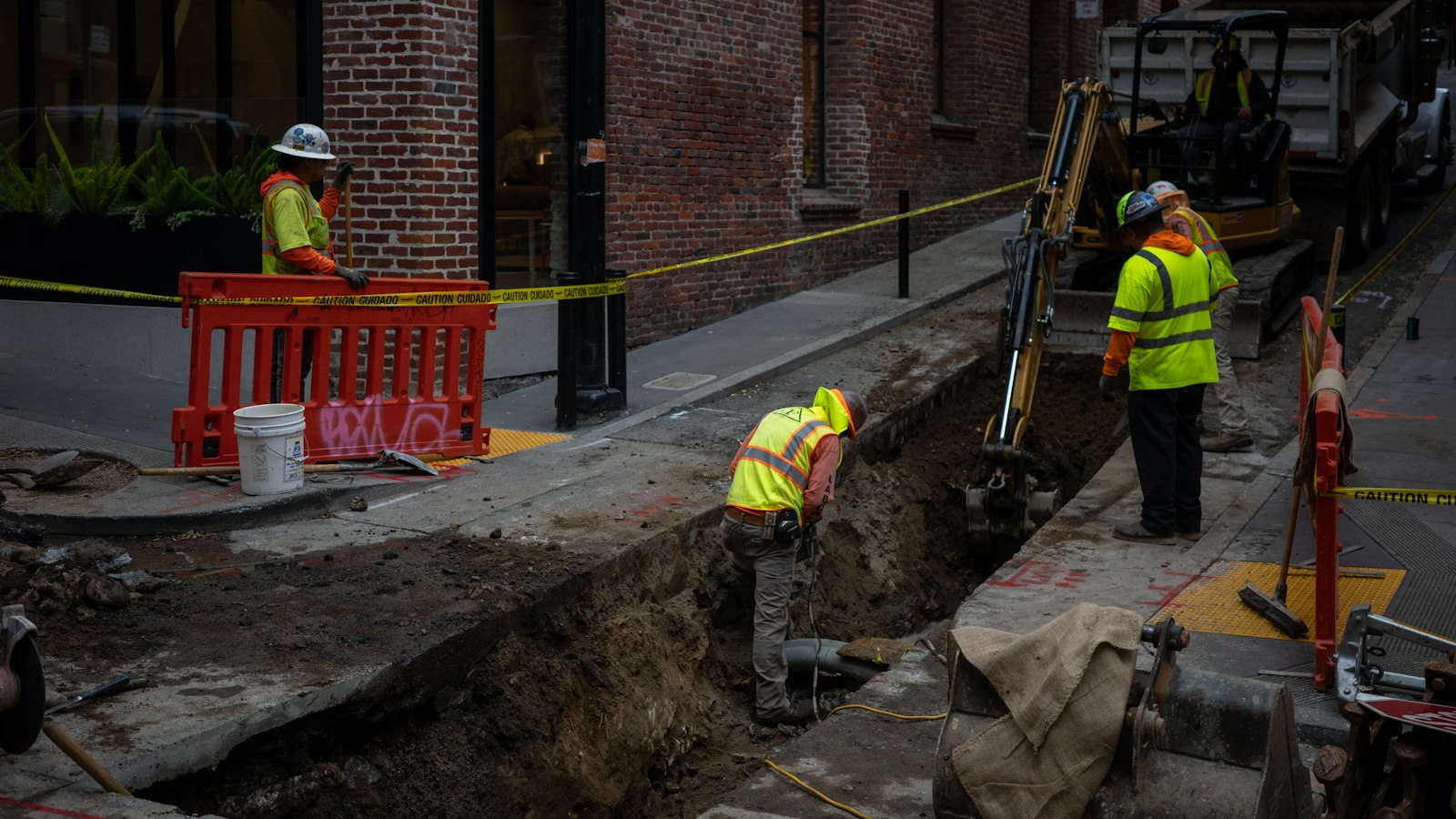
Replacing a sewer line costs $60–$250 per linear foot, which works out to roughly $3,000–$12,500 for a typical 50-foot lateral and $6,000–$25,000 for a long 100-foot run. The spread is wide because the real cost is in the digging: depth, what is on top of the pipe, and whether it runs under a slab.
One warning before the numbers. Many pages quote a national average near $3,000 ($3,319 at NearbyHunt, $3,320 at This Old House, $2,914 at Bob Vila). Those averages mix in spot repairs and short fixes. If you need the whole line replaced, plan on the per-foot math instead, and get a camera inspection first to find out what you actually need.
What drives the price
Length. Most residential laterals run 40–75 feet from the house to the city main, according to NearbyHunt. Inspect and Test says 50–100 feet is typical. Every extra foot is another $60–$250.
Depth. Pipes buried eight to twelve feet deep or more need shoring and more excavation (Inspect and Test). Expect the bid to climb accordingly.
What is on top. A lawn is cheap to dig and cheap to fix. A driveway, a mature tree, a patio or a street crossing is not. Concrete repair after an open-cut dig is $1,500–$4,000 (NearbyHunt). Municipal street work and permits can add thousands more.
Pipe material. PVC and ABS are the cheap, standard choices. This Old House lists PVC at $120–$320 in materials and ABS at $120–$440, versus $800–$3,000 for 40 feet of cast iron and $1,200–$3,200 for copper. Nobody should install copper or cast iron for a sewer lateral today unless a code or a unique site requires it.
Location. A line under a slab in a Florida or Texas house is a different job. Bob Vila prices pipe under a concrete slab at $300–$350 per foot. NearbyHunt notes that urban markets in the Northeast and on the West Coast run 20%–40% higher in labor.
Sewer line replacement prices at a glance
Cost per linear foot by method
| Method | NearbyHunt | Bob Vila | Inspect and Test |
|---|---|---|---|
| Open-cut (traditional trench) | $60–$150 | $50–$250 | $50–$250 |
| Pipe bursting (trenchless) | $150–$190 | $60–$200 | $60–$200 |
| Cured-in-place pipe lining (CIPP) | $135–$250 | $80–$250 | $80–$250 |
Total cost by job size
| Job | Typical total |
|---|---|
| Minor spot repair | $150–$1,050 |
| Partial replacement (about 20 ft) | $1,200–$5,000 |
| Full replacement (50 ft) | $3,000–$12,500 |
| Full replacement (100 ft) | $6,000–$25,000 |
| CIPP lining, typical residential line | $1,900–$6,000 |
Extras and add-ons
| Item | Cost | Source |
|---|---|---|
| Sewer camera inspection | $100–$500 | This Old House, NearbyHunt, Bob Vila |
| Permit | $150–$1,000 | NearbyHunt; This Old House says $100–$1,000, Bob Vila about $200 |
| Difficult access (obstacles, lines under concrete) | $400–$1,200 or more | This Old House |
| Pipe under a concrete slab | $300–$350 per foot | Bob Vila |
| Driveway concrete repair after open-cut | $1,500–$4,000 | NearbyHunt |
| Landscaping and sod repair | $500–$2,500 | NearbyHunt |
| Tree root removal | $100–$600 | Bob Vila; This Old House says $80–$1,000 |
| Sewer trap replacement | $1,500–$3,000 | Bob Vila |
Trenchless or open-cut
Trenchless methods dig two small access pits rather than a trench the full length of the line. They are not always cheaper. Open-cut runs $50–$250 per foot and trenchless $60–$250, so on price alone they overlap heavily. What trenchless saves is the repair to everything on top of the pipe.
Pipe bursting pulls a new pipe through the old one while breaking the old one apart. It works well when the old pipe is cracked, rooted or collapsed in places, and it is the better choice when the line crosses a driveway, patio or mature landscaping.
CIPP lining inserts a resin liner and cures it in place, leaving a pipe inside a pipe. It is quicker and cheaper on short, intact runs (NearbyHunt gives $1,900–$6,000 for a typical residential line), and manufacturers commonly rate liners for around 50 years (Inspect and Test). It does not work on a fully collapsed pipe or one with a major belly or offset.
Open-cut is the old standby and often the right answer when the line is shallow, the yard is open and the pipe has serious grade problems, because it lets the plumber correct the slope.
Get a camera inspection first
Before anyone quotes a replacement, pay for a camera inspection. It costs $100–$500 (This Old House, NearbyHunt, Bob Vila) and tells you where the problem is, how bad it is and how long the line is. A root-clogged joint 15 feet from the house may be a $1,200–$5,000 partial replacement instead of a $10,000 full one.
Ask for the video file, not just a verbal summary. If one contractor says full replacement and another says spot repair, you can send the same footage to both. A sewer line inspection is also a standard step if you are buying an older house. Clay, cast iron and Orangeburg (a tar-paper pipe) lines are the usual suspects.
Bob Vila's list of warning signs is useful: multiple drains clogging at once, recurring clogs, gurgling pipes, sewage smells, backups, soggy or unusually green patches in the yard, and wall or foundation cracks.
Labor and who to hire
Sewer work is excavation plus plumbing, so you want a licensed plumbing or sewer contractor with their own equipment, not a general handyman. Labor is quoted differently by source: $45–$200 an hour (NearbyHunt), $50–$150 (Bob Vila), and $150–$500 (This Old House, which looks high for a normal crew). The Bureau of Labor Statistics reports a median wage of $30.67 an hour for plumbers, pipefitters and steamfitters (May 2025). Contractors bill well above wages because they carry excavators, insurance and bonding.
Most sewer jobs are priced per foot or as a lump sum, not by the hour. Ask what is included: pipe, fittings, cleanout, connection at the house and at the main, permit, inspection, backfill and restoration.
Permits and hidden costs
A sewer replacement almost always needs a permit and a city inspection, and sometimes a right-of-way permit if the work reaches the street. Fees range from about $100 to $1,000 depending on the municipality (This Old House, NearbyHunt).
The cost that surprises people most is restoration. A tidy open-cut trench through a lawn is a $500–$2,500 sod and landscaping job, but a cut driveway is $1,500–$4,000 on top of the plumbing. If the quote says restoration is by others, ask who and for how much.
Check your homeowner's policy, too. Many standard policies do not cover the sewer line itself, only damage that results from a backup. Some cities and utilities offer service line warranty programs or low-interest repair loans, and those are worth a phone call before you sign.
How long a new line lasts
Inspect and Test says a new sewer line typically lasts 50–100 years or more when installed correctly. This Old House gives 100 or more years for PVC and 75–100 years for cast iron with proper care. That makes replacement a one-time cost for most owners, and it is a reason to put in a proper, graded PVC line rather than patching a failing one for the third time.
If you are selling in the next couple of years, a lined or replaced sewer is also an easy thing to document for a buyer's inspector.
Sample estimate
Illustration
Sample estimate: 60-foot pipe bursting replacement under a driveway, Cincinnati-area home
- Sewer camera inspection
- $250
- Permit and inspection
- $300
- Pipe bursting, 60 feet at $150 per foot
- $9,000
- Sod and landscaping repair at both access pits
- $800
- Total
- $10,350
An illustration using NearbyHunt's per-foot pipe bursting range ($150–$190) and the mid-range of inspection, permit and landscaping costs. Bob Vila and Inspect and Test put pipe bursting lower, at $60–$200, so quotes can come in under this. It is not a quote.
Ways to bring the price down
- Pay for the camera inspection. At $100–$500, it can turn a full replacement into a $1,200–$5,000 partial one.
- Ask for both a trenchless and an open-cut price if the line is under grass only. On open ground open-cut is often the cheapest.
- Do the work before it collapses. A planned job avoids emergency rates and the $500–$2,500 landscaping repair on top of a blown-out yard.
- Check whether your city or utility runs a lateral repair program or offers a service line warranty before you hire.
- Get three itemized bids that say who handles the permit, the city inspection and the restoration. Per-foot prices that exclude these are not comparable.
- Replace the part that failed, if the rest is sound. If the camera shows only one bad joint, partial replacement of about 20 feet runs $1,200–$5,000 (NearbyHunt).
Frequently asked questions
How much does it cost to replace a sewer line per foot?
$60–$250 per foot for most methods. NearbyHunt averages about $150 per foot. Bob Vila and Inspect and Test put pipe bursting at $60–$200 and lining at $80–$250, while open-cut runs $50–$250.
How much does it cost to replace a 100-foot sewer line?
NearbyHunt puts a full 100-foot replacement at $6,000–$25,000. At $60–$250 per foot, the math agrees. Deep lines, driveways and slabs push you toward the top of that range.
Is trenchless sewer replacement cheaper?
Not necessarily. Per-foot prices overlap with open-cut. Trenchless saves money on restoration when the pipe runs under a driveway, patio or mature landscaping.
How do I know if my sewer line needs replacing?
Multiple drains clogging at once, recurring backups, gurgling pipes, sewage smell and soggy spots in the yard are the usual signs (Bob Vila). A camera inspection at $100–$500 confirms it.
Does homeowners insurance cover sewer line replacement?
Usually not for wear and tear. Many policies cover damage from a backup only if you have a sewer or water backup endorsement. Read your policy or ask your agent, and check whether your city offers a service line warranty program.
How long does sewer line replacement take?
I did not find a reliable national figure in the sources I opened, so ask your contractor for a schedule in writing. Trenchless methods are generally quicker than open-cut because there is less digging and restoration.
Sources
We compare several independent sources for every guide and say where they disagree. Pages were last checked on the dates shown.
- Sewer Line Replacement Cost (opens in a new tab), This Old House. Accessed November 22, 2026. Used for: average, pipe materials, permits, camera inspection, access and restoration costs, lifespan
- Sewer Line Replacement Cost: 2026 Pricing Guide (opens in a new tab), NearbyHunt. Accessed November 22, 2026. Used for: per-foot costs by method, totals by length, restoration costs, regional differences
- How Much Does Sewer Line Replacement Cost? (opens in a new tab), Bob Vila. Accessed November 22, 2026. Used for: typical range and average, per-foot by method, under-slab cost, signs of failure
- Sewer Line Replacement Cost (opens in a new tab), Inspect and Test. Accessed November 22, 2026. Used for: planning ranges by method, lifespan, typical length and depth
- Plumbers, Pipefitters, and Steamfitters: Occupational Outlook Handbook (opens in a new tab), U.S. Bureau of Labor Statistics. Accessed November 22, 2026. Used for: median hourly wage for plumbers (May 2025)
How we put this guide together
We don't take money from contractors or sell your details. Ranges come from published national price data, wage statistics and installer price lists, cross-checked and rounded. Read how we price or tell us if a number looks off in your area via our contact page.
Related cost guides
Septic tank
Typical installed cost of a new septic system, national average
$4,500–$9,000Repipe
Whole-house PEX repipe, 1,500–2,500 sq ft home, supply lines only
$5,500–$14,000Water heater replacement
Installed cost to swap a standard 40–50 gallon tank water heater, gas or electric
$700–$2,300Foundation repair
Typical total for one foundation repair job, crack repair through a handful of piers
$2,200–$8,200Driveway
Typical installed cost of a new driveway, national average and range (Fixr, mixed materials)
$3,200–$10,000