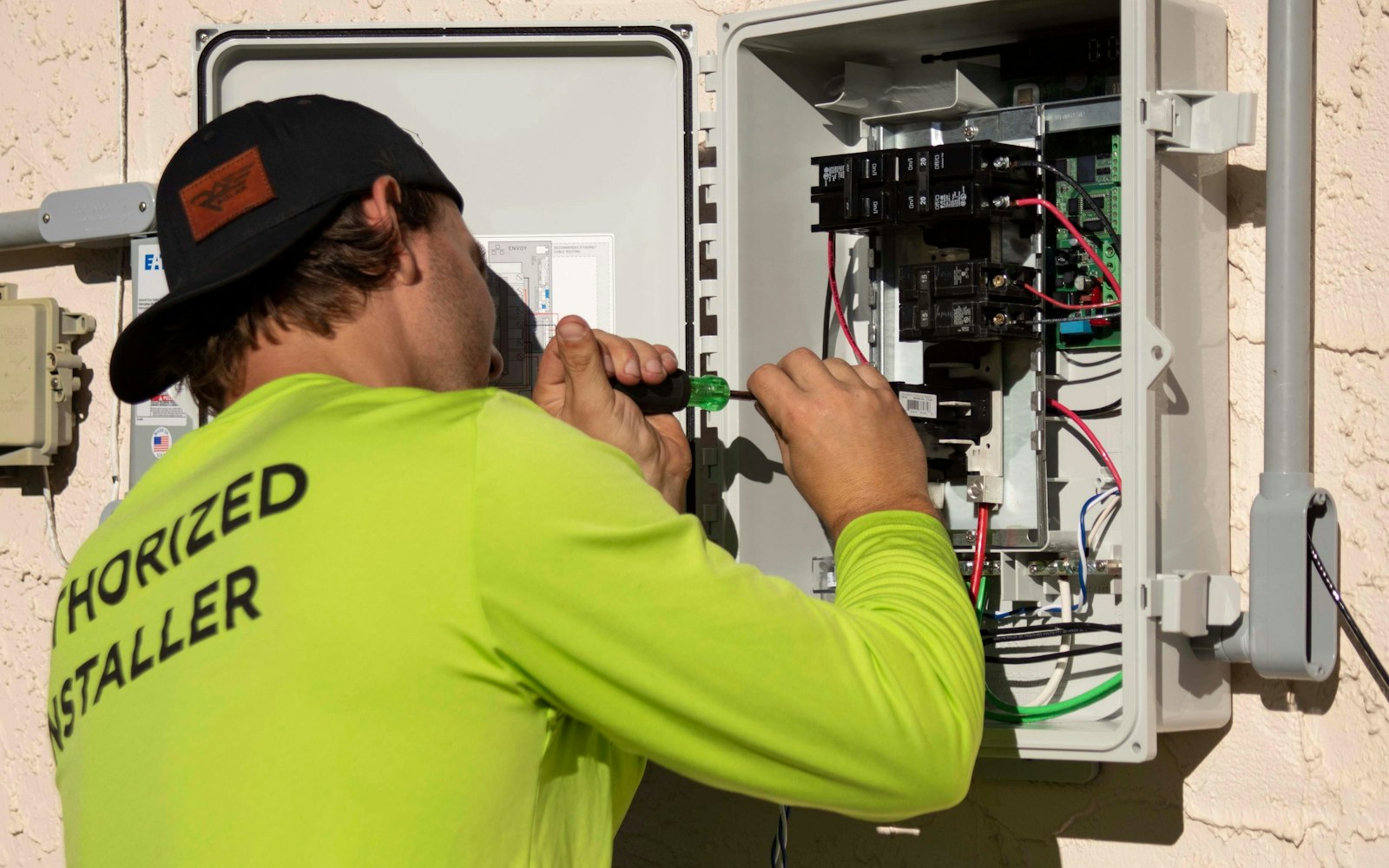
Rewiring a typical 2,200 sq ft house costs about $7,300–$13,300, with roughly $10,300 as the midpoint. That is $3–$6 per square foot for new wiring, outlets and fixtures. If the walls are hard to get into, the real total can run well above that.
The wire is not the expensive part. You are paying for an electrician's time, a permit and inspection, and the work of getting cable through finished walls and ceilings. Most of the price swing between quotes comes from access and from what happens to the drywall afterward.
What drives the price
Size is the base. Fixr's totals scale from $2,318–$4,218 for a 700 sq ft home to $9,936–$18,078 for 3,000 sq ft, which is the same $3–$6 per sq ft applied to more floor area.
Access is the biggest multiplier. A house with an open basement, an unfinished attic and a crawlspace lets an electrician pull cable without touching drywall. A finished two-story with plaster walls and no easy chase is a different job. Bob Vila prices a 1,250 sq ft house with walls opened at $7,500–$15,000, which is far above the $3–$5 per sq ft it quotes for an easier job.
Then comes scope. Wiring alone with no outlets, switches or fixtures is $1.00–$1.85 per sq ft at Fixr. Add devices and you are at $3–$6. A quote that only covers rough-in is not the same job as a quote that finishes the house.
Finally, what you leave to others. If you do the drywall and paint yourself, you save the 25–30% that Bob Vila says wall repair can add.
House rewiring prices at a glance
Cost by home size
| Home size | Fixr | Bob Vila |
|---|---|---|
| 700 sq ft | $2,318–$4,218 | not listed |
| 1,000 sq ft | $3,312–$6,026 | $3,000–$5,000 |
| 1,700 sq ft | $5,630–$10,244 | not listed |
| 2,200 sq ft | $7,286–$13,257 | not listed |
| 3,000 sq ft | $9,936–$18,078 | $9,000–$15,000 |
Cost per square foot
| Scope | Cost per sq ft |
|---|---|
| New wiring, with outlets and light fixtures (Fixr) | $3.00–$6.00 |
| New wiring, without fixtures or fixed appliances (Fixr) | $1.00–$1.85 |
| Whole-house rewire (Bob Vila) | $3–$5 |
Labor, permits and wall repair
| Item | Typical cost |
|---|---|
| Electrician labor (Bob Vila) | $40–$100 per hour per worker |
| Electrical company rate (Bob Vila) | $65–$85 per hour per worker |
| Permit (Bob Vila) | starting around $250, up to $500 or more |
| Permit and inspection combined (Bob Vila) | $200–$900 |
| Permit or inspection (Fixr) | up to a few hundred dollars each |
| Wall repair after opening walls (Bob Vila) | 25–30% of project cost |
| 1,250 sq ft home, walls opened and rewired (Bob Vila) | $7,500–$15,000 |
| Large or minimal-access home (Bob Vila) | up to $30,000 |
Do you actually need a full rewire?
Not every old house does. A full rewire is a big, disruptive job, and some problems can be fixed for a lot less.
The cases that usually justify it are old cloth-covered or knob-and-tube wiring, aluminum branch wiring from the 1960s and 1970s, and wiring that has been damaged by rodents, water or earlier DIY work. Bob Vila calls knob-and-tube antiquated and aluminum a fire risk worth updating. Neither Bob Vila nor Fixr gives a separate price for those two cases, so do not expect a different rate until an electrician has looked.
Symptoms to take seriously include breakers that trip often, outlets that are warm or discolored, flickering lights, two-prong outlets throughout, and a fuse box. Those may point to a panel or a few bad circuits instead of the whole house. Ask for a written inspection first. A partial rewire of one floor or a few circuits costs a fraction of $10,000, and an electrician can tell you what the house actually needs.
Labor, timing and who you hire
Bob Vila lists $40–$100 per hour per worker, and $65–$85 per hour at electrical companies. The Bureau of Labor Statistics shows electricians earned a median of $30.38 per hour, or $63,190 per year, in May 2025. The billing rate is higher than the wage because it covers insurance, tools, trucks and overhead.
Rewiring is not a handyman job. Hire a licensed electrician, ask for the license number and check it with your state board. Ask who pulls the permit. If the answer is you, walk away.
Time is part of the price. Fixr says an average house takes about a week, and up to three weeks depending on size and complexity. In extreme cases it takes more than a month. Bob Vila says 3 to 10 days. If you live in the house, plan for days without power to parts of it, and ask how the crew will stage the work.
Timing, disruption and what to expect
Fixr says rewiring an average home takes about a week and can run up to three weeks depending on size and complexity. Bob Vila gives 3 to 10 days. Either way, plan for more than one visit, because rough-in, inspection and finish are separate stages.
Expect holes in walls and ceilings, power off in sections of the house during the day, and a lot of dust. Move furniture away from the walls being worked on and cover what you cannot move. If you work from home, ask which circuits will be dead on which days so you can plan around it.
The schedule often slips at the inspection. The inspector may need to see the wiring before the walls are closed, so the patching crew has to wait. Ask your electrician how they schedule that and whether the final inspection is included in the price.
Permits and inspection
Permits are required nearly everywhere for a rewire. Bob Vila puts a permit at roughly $250 to $500 or more, and permit plus inspection at $200–$900. Fixr says permits and inspections can each run to a few hundred dollars.
The inspector checks wire gauge, breaker sizes, grounding, box fill and that the work matches the permit. Do not skip it. An unpermitted rewire can cause problems when you sell and may complicate an insurance claim.
In many jurisdictions the contractor pulls the permit and includes it in the quote. Fixr says permit costs are included in the electrician's estimate. Confirm it is in writing.
The part people forget: opening and closing walls
Drywall and plaster are where rewiring budgets slip. Bob Vila says wall repairs can add 25 to 30 percent to the project cost. On a $9,000 rewire, that is $2,250–$2,700.
Someone has to patch the holes, texture them, prime and paint. Ask your electrician whether the quote includes patching or only rough-in. If you plan to repaint anyway, the patching is the cheaper half of the work, and you can bundle it with a room refresh.
Bob Vila also notes that cleanup is usually in a wall contractor's bid but may not be in an electrician's, so ask about dust control. Wiring work in an older house disturbs a lot of dust, and if the house has lead paint or asbestos materials, testing should come before anyone cuts into the walls.
Rewiring and the electrical panel
A rewire is the best time to look at the panel. If the house still has a 60-amp or 100-amp service and you want an EV charger, heat pump or induction range, upgrading it as part of the project can save a second permit and a second visit. Our electrical panel upgrade guide covers the costs in detail.
That said, none of the sources I opened for this guide give a bundled price for panel plus rewire, so treat any combined quote as something to itemize. Ask for the panel, the circuits and the wall repair as separate lines so you can see where the money goes.
Full rewire or partial, and what you can do yourself
A full rewire replaces nearly every cable in the house. A partial job targets one floor, one wing or a handful of circuits, and it is the right call more often than people expect.
Start with the size math. At Fixr's $3–$6 per sq ft, rewiring only a 700 sq ft section of a larger house would run roughly the $2,318–$4,218 Fixr lists for a 700 sq ft home, though a section inside a bigger house can cost more or less depending on how it ties back to the panel. That is a fraction of the $9,936–$18,078 Fixr gives for a 3,000 sq ft house.
A partial rewire makes sense when the bad wiring is isolated, for example an old addition, a kitchen that was never brought up to date or a basement with exposed splices. It does not make sense when the whole house still has the same original wiring, because you will pay for mobilization, a permit and wall repair twice.
Ask the electrician to price both versions. If the full job is only a few thousand dollars more, doing it once usually wins, especially if walls are open for a remodel anyway. If the difference is large, fix the worst circuits now and plan the rest.
Can you do any of it yourself?
Most of the safe savings are on the finishing side, not the wiring. Bob Vila says wall repairs can add 25 to 30 percent of the project cost, and Fixr suggests that homeowners can handle drywall repair themselves to keep costs down. Patching, sanding, priming and painting are all things a patient homeowner can do.
The wiring itself is different. Cable runs, box fill, grounding and panel connections are code work, and in most places a licensed electrician has to do them and an inspector has to sign off. A DIY rewire that fails inspection costs more than it saves, and one that is never inspected is a problem when you sell.
A sensible split is to let the electrician do all the wiring and tie-in, then do your own demolition cleanup, patching and paint. Agree on that in the written quote so the electrician does not price in the finishing work.
How to compare quotes
Get three written quotes. Each should state the wire type, the number of circuits, how many outlets, switches and fixtures are included, whether the panel is part of the job, and who handles permits, inspection, patching and cleanup.
Divide each total by the square footage. Fixr's range of $3–$6 per sq ft for a full job is your yardstick. A quote at $1 to $2 per sq ft is probably rough-in only. A quote far above $6 should come with a reason, such as plaster walls or a hard-to-reach layout.
Be careful with anyone who wants a large deposit, will not pull a permit, or cannot explain how they will get cable to the second floor without opening the walls.
Sample estimate
Illustration
Sample estimate: 1,800 sq ft two-story house, walls partly opened
- Rewiring with outlets and fixtures, 1,800 sq ft at $4.50
- $8,100
- Permit and inspection
- $600
- Drywall patching and paint (about 25% of the wiring cost)
- $2,025
- Total
- $10,725
An illustration using Fixr's $3–$6 per sq ft range, Bob Vila's $200–$900 permit and inspection range and its 25–30% wall repair figure, not a quote. It assumes no panel upgrade.
Ways to bring the price down
- Ask for a written inspection first. A partial rewire of the bad circuits costs a fraction of a full $7,300–$13,300 job.
- Do your own drywall patching and painting. Bob Vila says wall repair can add 25–30% to the cost.
- Pick a time when the house is empty or the walls are already open for a remodel, so access costs less.
- Bundle the panel upgrade with the rewire so you pay for one permit cycle and one visit.
- Compare quotes per square foot against Fixr's $3–$6, and ask what is left out of the cheapest one.
- Run wiring through basement, attic and crawlspace routes where possible, so fewer walls are opened.
Frequently asked questions
How much does it cost to rewire a 2,000 sq ft house?
At Fixr's $3–$6 per sq ft, that is about $6,000–$12,000. Fixr lists $5,630–$10,244 for 1,700 sq ft and $7,286–$13,257 for 2,200 sq ft, so 2,000 sq ft falls between them.
How much does it cost to rewire a house per square foot?
Fixr gives $3–$6 per sq ft with outlets and fixtures and $1.00–$1.85 without them. Bob Vila gives $3–$5 per sq ft.
How long does it take to rewire a house?
Fixr says about a week for an average home and up to three weeks for larger or more complex jobs. Bob Vila says 3 to 10 days.
Do I need a permit to rewire a house?
Yes, in nearly every jurisdiction. Bob Vila lists permits at about $250 to $500 or more, and permit plus inspection at $200–$900. Your electrician normally pulls it.
Can I live in my house while it is rewired?
Often, yes, but expect days with power off to parts of the house and a lot of dust. Ask the electrician how they will stage the work, and about dust control.
How much does wall repair add to a rewire?
Bob Vila says wall repairs can add 25 to 30 percent of the project cost. Confirm whether the electrician's quote includes any patching.
Is knob-and-tube or aluminum wiring a reason to rewire?
Bob Vila calls knob-and-tube antiquated and aluminum wiring a fire risk worth updating. Neither it nor Fixr lists a separate price, so get an electrician's inspection and a written quote.
Sources
We compare several independent sources for every guide and say where they disagree. Pages were last checked on the dates shown.
- Electrical Wiring Cost (opens in a new tab), Fixr. Accessed November 22, 2026. Used for: range for a 2,200 sq ft home, cost per sq ft, totals by home size, permits and inspection, duration
- Cost to Rewire a House (opens in a new tab), Bob Vila. Accessed November 22, 2026. Used for: cost per sq ft, totals for 1,000 and 3,000 sq ft homes, labor rates, permits, wall repair share, walls-opened totals
- Electricians, Occupational Outlook Handbook (opens in a new tab), U.S. Bureau of Labor Statistics. Accessed November 22, 2026. Used for: median hourly and annual wage, May 2025
How we put this guide together
We don't take money from contractors or sell your details. Ranges come from published national price data, wage statistics and installer price lists, cross-checked and rounded. Read how we price or tell us if a number looks off in your area via our contact page.
Related cost guides
Electrical panel upgrade
Typical total to replace a main panel with a 200-amp panel, labor and permit included
$1,300–$4,500Kitchen remodel
Typical total for a mid-range kitchen remodel with new cabinets, counters, flooring and appliances
$25,000–$60,000Bathroom remodel
Typical total for a full remodel of an average bathroom (not a luxury spa build)
$6,500–$25,000Heat pump
Installed air-source heat pump, ducted whole-home system
$5,000–$15,000