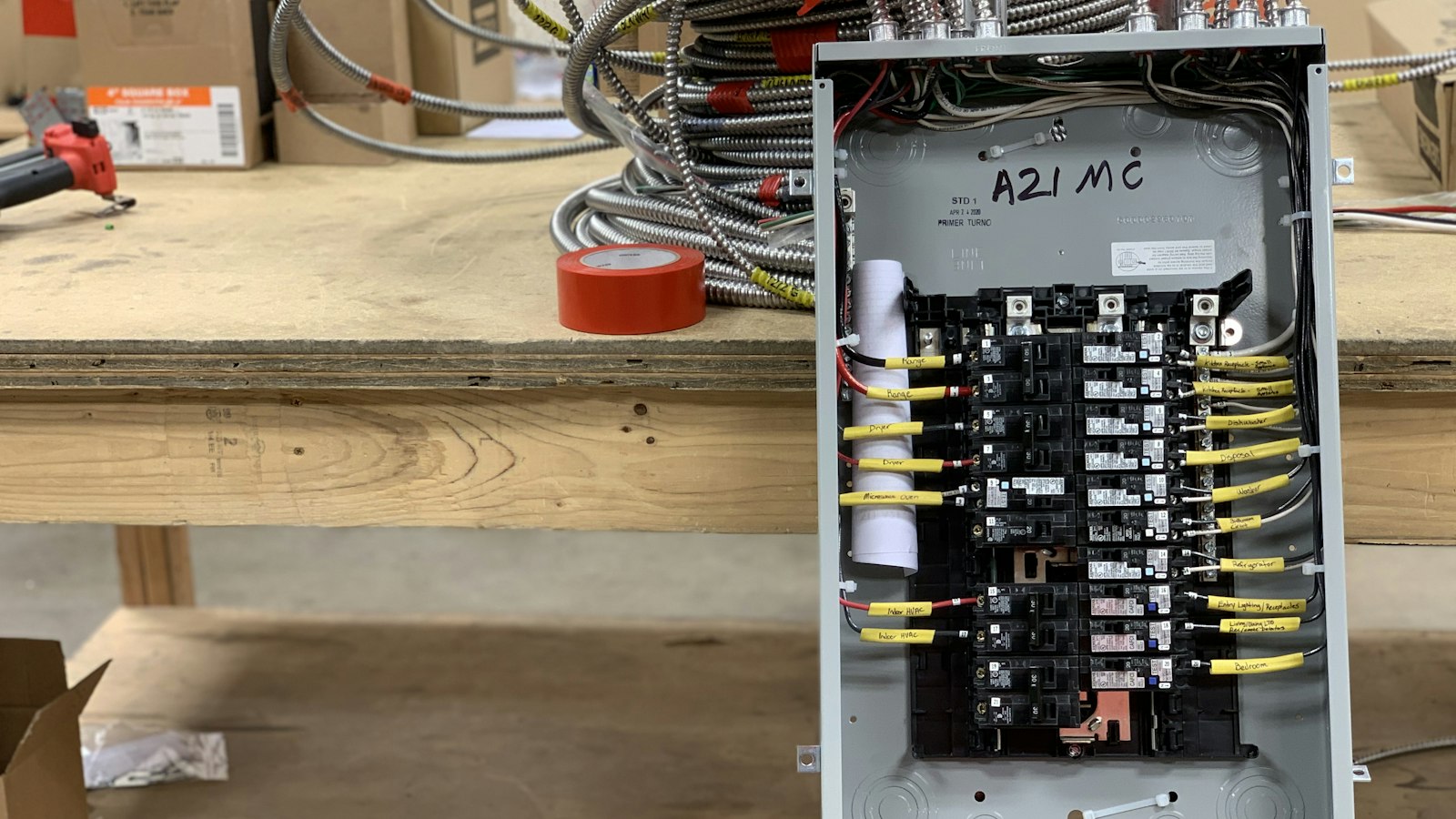
Replacing or upgrading your main electrical panel to 200 amps typically costs $1,300–$4,500, with about $2,500 as a common result. A simple swap in the same spot is at the low end. A 400-amp service or a job that involves the utility side can cost $8,000 or more.
The box and breakers are a small part of the bill. You are mainly paying for a licensed electrician, a permit, an inspection and, in some houses, new service equipment on the outside of the house.
What drives the price
Four things move the price: the size of the new service, whether the work is only inside the house, where the panel sits, and the condition of what is attached to it.
Amperage is the obvious one. Going from 100 to 200 amps costs more because the service conductors and the main breaker are bigger. Fixr's range is $1,800–$4,500 for 200 amps against $1,200–$1,800 for a straight 100-amp replacement.
The utility side is the biggest cost wildcard. If your meter socket, weatherhead or service cable cannot handle the new load, the work leaves the panel. This Old House shows meter box installation at $1,800–$3,500 on top of the panel, and the work may involve the utility.
Location is next. Moving a panel from a basement to a garage, or indoors to outdoors, runs $800–$3,000 at This Old House and $1,500–$2,500 for indoor-to-outdoor moves at Bob Vila.
Condition is the last one. A fuse box replacement runs $200–$2,000 at Bob Vila, and a damaged bus bar can add $500–$2,000.
Electrical panel upgrade prices at a glance
Cost by amperage
| Service size | Fixr (installed) | This Old House (panel and installation) | This Old House (panel only) |
|---|---|---|---|
| 100 amp | $1,200–$1,800 | $800–$1,500 | $100–$200 |
| 150 amp | $1,500–$2,800 | not listed | not listed |
| 200 amp | $1,800–$4,500 | $1,300–$3,000 | $250–$350 |
| 300 amp | not listed | $1,800–$3,500 | $350–$500 |
| 400 amp | $8,000–$12,000 | $2,000–$4,000 | $500+ |
Add-on costs
| Item | Typical cost |
|---|---|
| Permit | $50–$300 or more |
| Electrical inspection | $125–$250 |
| Main breaker replacement | $200–$300 (up to $500–$2,000 if the bus bar is damaged) |
| Subpanel installation | $400–$1,750 |
| Meter box, unit only | $50–$250 |
| Meter box, installation | $1,800–$3,500 |
| Moving a panel | $800–$3,000 |
| AFCI or GFCI breaker | $35–$60 each (TOH), AFCI $50–$100 (Bob Vila) |
| Panel rewiring | $500–$4,500 |
Cost by panel type
| Panel type | Cost |
|---|---|
| Fuse box replacement | $200–$2,000 |
| Main breaker panel | $500–$2,000 |
| Main lug panel | $400–$1,750 |
| Subpanel | $530–$1,940 |
Do you actually need an upgrade?
A lot of homes need a panel replaced for the same few reasons. The main breaker is rated for 60 or 100 amps and you are adding an EV charger, heat pump, induction range or an addition. The panel has visible rust, scorching or a breaker that will not reset. You still have a fuse box and your insurer will not renew. Or you are out of spaces and have been doubling up circuits.
On the other hand, a panel that has room, shows no damage and carries your actual load does not need replacing just because it is old. The sources I reviewed do not set an age rule. Ask an electrician to do a load calculation. If the answer is a subpanel, that is $400–$1,750 at This Old House, against $1,800–$4,500 for a full 200-amp service.
Labor and who you hire
Fixr says labor is 40–60% of the job and electricians charge $40–$120 per hour. Bob Vila gives $50–$150 or more per hour and a typical job of 20 to 30 hours, which is more than many installers need for a straightforward swap. The Bureau of Labor Statistics shows a median wage of $30.38 per hour for electricians as of May 2025, with the top 10% above $108,510 per year. Billing rates sit well above that because they include insurance, truck, tools and overhead.
Hire a licensed electrician, not a handyman. Panel work is dangerous and, in most places, legally restricted. Ask for the license number, check it with your state board, and ask who will pull the permit. The contractor pulling it is the norm.
Permits and inspection
A permit is required nearly everywhere for a panel replacement. Fixr and This Old House both quote $50–$300 or more depending on the jurisdiction. Bob Vila also lists an inspection at $125–$250.
The inspector checks grounding, breaker sizing, labeling, clearances and that the work matches the permit. Do not let anyone talk you out of the inspection. An unpermitted panel can cause problems when you sell, and may give your insurer an excuse to deny a claim.
Related costs people forget
Wall repair is the quiet one. A new panel can be larger than the old one, and Bob Vila lists drywall at $1.50–$3 per sq ft. Grounding is another: Bob Vila lists copper grounding at about $1.50 per linear foot and trenching at $6 per linear foot if a new service run is needed.
Breakers matter too. Modern codes require arc-fault and ground-fault protection on many circuits. This Old House puts those at $35–$60 per breaker, and Bob Vila at $50–$100 for AFCI. Replacing ten of them adds $350–$1,000 in parts alone.
The last cost is rewiring. If the inspector finds aluminum or knob-and-tube wiring, panel rewiring runs $500–$4,500 at Bob Vila, and whole-house rewiring $12,000–$20,000. That is a separate project, but it is better to find it now.
How to compare quotes
Ask each electrician for a written quote that names the new service size, brand, number of spaces, breakers included and whether the meter socket, mast and grounding are being replaced. Ask whether the permit, inspection and utility coordination are included.
Get three quotes. If one is far below the rest, it may leave out the permit or reuse an old meter base. If one is far above, ask what is bundled in. A load calculation should be offered without a fee.
Be wary of anyone who pushes for a quick decision or who does not mention a permit.
Sample estimate
Illustration
Sample estimate: 100-amp to 200-amp panel swap in a 1980s ranch, meter base reused
- 200-amp main breaker panel and breakers
- $450
- Electrician labor to swap the panel and reconnect circuits
- $1,600
- Four AFCI breakers at $50
- $200
- Permit
- $150
- Electrical inspection
- $175
- Total
- $2,575
An illustration using ranges from This Old House, Fixr and Bob Vila, not a quote. It assumes the meter base and service cable can handle 200 amps. If they cannot, add $1,800–$3,500 for the meter box.
Ways to bring the price down
- Ask for a load calculation first. A subpanel at $400–$1,750 can cost far less than a full 200-amp service at $1,800–$4,500.
- Keep the panel in the same location. Moving it adds $800–$3,000.
- Buy breakers only for the circuits that need AFCI or GFCI protection. At $35–$100 each, they add up quickly.
- Bundle the work with an EV charger, heat pump or solar installation so the permit and visit are shared.
- Ask the electrician to quote the permit and inspection as separate lines, so you can see whether either is being marked up.
- Get three written quotes, and ask what happens if the utility side turns out to need work.
Frequently asked questions
How much does it cost to upgrade from 100 to 200 amps?
This Old House gives $1,300–$3,000 for a 200-amp panel with installation. Fixr gives $1,800–$4,500. Add meter and service equipment if they need replacing.
How much does an electrical permit cost?
$50–$300 or more, depending on the location, per Fixr, This Old House and Bob Vila. Bob Vila lists an inspection at $125–$250.
How long does a panel upgrade take?
Bob Vila estimates a typical job at 20 to 30 hours of electrician time. Coordination with the utility can add days, so ask for a schedule in writing.
How much does a new electrical panel itself cost?
This Old House puts the panel alone at $100–$200 for 100 amps and $250–$350 for 200 amps. The labor and permit are most of the bill.
Can I replace a panel myself?
I would not. The service conductors stay live from the utility, the work is restricted to licensed electricians in many places and you need an inspection to pass.
How much does a 400-amp panel cost?
Fixr says $8,000–$12,000 for a 400-amp upgrade. This Old House lists $2,000–$4,000 for panel and installation, plus separate meter and service work. Get a written quote.
What does a subpanel cost?
This Old House gives $400–$1,750 for installation. Bob Vila gives $530–$1,940. Fixr lists $100–$400 for materials alone.
Sources
We compare several independent sources for every guide and say where they disagree. Pages were last checked on the dates shown.
- Electrical Panel Upgrade Cost (opens in a new tab), Fixr. Accessed November 22, 2026. Used for: national average and range, cost by amperage, labor share and hourly rates, permit, subpanel materials
- Cost to Upgrade an Electrical Panel (opens in a new tab), This Old House. Accessed November 22, 2026. Used for: average and range, cost by amperage table, permit, add-ons
- Cost to Replace an Electrical Panel (opens in a new tab), Bob Vila. Accessed November 22, 2026. Used for: cost by panel type, hourly rates and job hours, inspection, related add-ons
- Electricians, Occupational Outlook Handbook (opens in a new tab), U.S. Bureau of Labor Statistics. Accessed November 22, 2026. Used for: median wage and percentiles, May 2025
How we put this guide together
We don't take money from contractors or sell your details. Ranges come from published national price data, wage statistics and installer price lists, cross-checked and rounded. Read how we price or tell us if a number looks off in your area via our contact page.
Related cost guides
House rewiring
Typical total to rewire a 2,200 sq ft house, materials and labor, with outlets and fixtures
$7,300–$13,300Kitchen remodel
Typical total for a mid-range kitchen remodel with new cabinets, counters, flooring and appliances
$25,000–$60,000Bathroom remodel
Typical total for a full remodel of an average bathroom (not a luxury spa build)
$6,500–$25,000Heat pump
Installed air-source heat pump, ducted whole-home system
$5,000–$15,000Solar panel
Typical 12 kW home solar system, installed, before incentives (EnergySage)
$27,526–$33,869