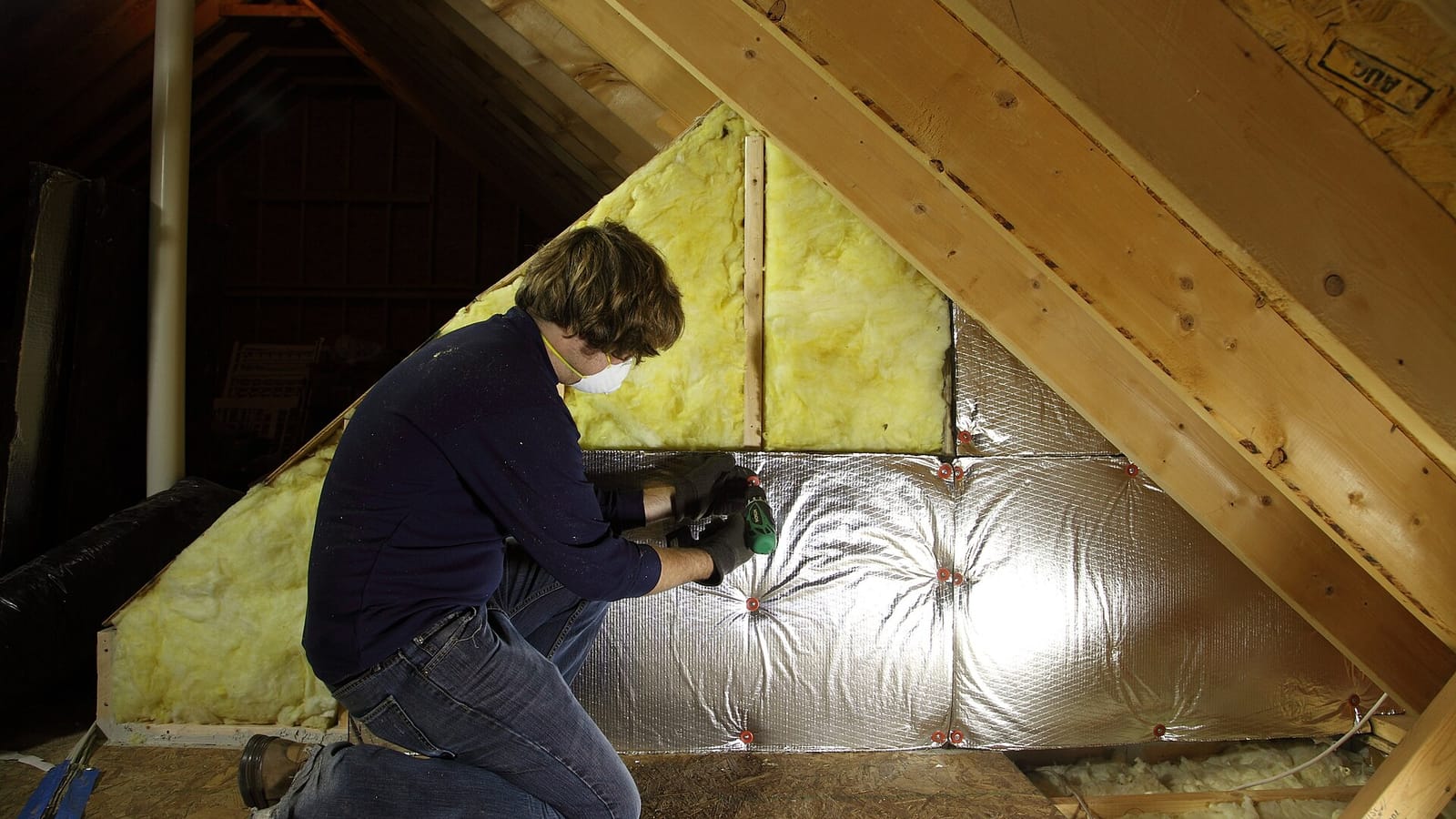

Insulating a 1,000 sq ft attic typically costs $2,000–$3,250, with about $2,500 as the average. That works out to $2–$3.25 per square foot installed. Topping up an attic that already has some insulation can come in near $500, while spray foam in a big attic can pass $10,000.
Most of the spread comes from three choices: the material you pick, whether old insulation has to come out first, and whether anyone seals the air leaks before the new layer goes down. The sections below sort out which of those are worth paying for.
What drives the price
Material is the first lever. Fiberglass is the cheap option and spray foam is the expensive one, with cellulose and mineral wool in between. At Bob Vila, blown-in fiberglass material runs $0.50–$1.10 per sq ft, cellulose $0.60–$2.30 and rockwool $1.40–$2.10. Fixr's installed totals for the same job run from $500–$2,000 for fiberglass up to $2,500–$12,000 for spray foam.
Size and depth come next. Going from R-30 to R-60 means roughly twice the material. Bob Vila's example is about $500 of fiberglass to reach R-30 in a 1,000 sq ft attic and about $1,060 to reach R-60. Labor does not double, so deeper insulation is often a good deal per R-point.
Access matters more than people expect. A walk-up attic with a floor you can stand on is simple. A low, crawl-through attic with a tight hatch takes longer, and any wiring, can lights and ductwork in the way mean the crew has to work around them. Bob Vila notes that insulating near wiring may call for an electrician at $50–$100 per hour.
Last, what is already up there. Wet, moldy or contaminated insulation has to come out first, and Fixr puts removal plus new insulation at $3,000–$6,250 for a typical attic.
Attic insulation prices at a glance
Cost by attic size
| Attic size | Installed cost range (Fixr) |
|---|---|
| 500 sq ft | $500–$3,500 |
| 750 sq ft | $750–$5,250 |
| 1,000 sq ft | $1,000–$7,000 |
| 1,200 sq ft | $1,200–$8,400 |
| 1,500 sq ft | $1,500–$10,500 |
Cost by insulation type
| Type | Installed cost (Fixr) | Material cost per sq ft (Bob Vila) |
|---|---|---|
| Batts (fiberglass) | $500–$1,500 | not listed |
| Blown-in fiberglass | $500–$2,000 | $0.50–$1.10 |
| Blown-in cellulose | $1,750–$5,500 | $0.60–$2.30 |
| Mineral wool (rockwool) | not listed | $1.40–$2.10 |
| Foam board | $2,500–$7,500 | not listed |
| Spray foam | $2,500–$12,000 | not listed |
Extra costs that change the bill
| Item | Typical cost |
|---|---|
| Removing old insulation | $1–$3 per sq ft ($1,000–$3,000 for a 1,000 sq ft attic) |
| Removal plus new insulation, typical attic | $3,000–$6,250 |
| Air sealing | $350–$1,500 |
| Mold remediation | about $2,216 on average |
| Asbestos removal or encapsulation | about $2,020 on average |
| Blower rental for DIY | $100–$200 for 24 hours |
Recommended attic R-value by climate zone
| Climate zone | Attic with no insulation | Attic with 3–4 inches already |
|---|---|---|
| 1 | R30 | R25 |
| 2 and 3 | R49 | R38 |
| 4, 5 and 6 | R60 | R49 |
| 7 and 8 | R60 | R49 |
Which type to choose
For an open attic floor, blown-in is the usual answer. A blower fills gaps around joists and obstructions that batts leave open, and it is fast. Fixr prices blown-in at $1,750–$5,500, though that range blends cellulose and fiberglass. Fiberglass is the cheaper of the two, and cellulose is denser.
Batts make sense for a small attic, a patch job, or a spot with a lot of framing in the way. They are the cheapest at $500–$1,500 at Fixr, but gaps and compression cut their real-world performance if the crew is careless.
Spray foam is the one I would be slowest to buy for a standard vented attic. Fixr's range is $2,500–$12,000, and that is a lot to pay for something you can match with blown-in at a fraction of the price. It earns its cost when you are insulating the underside of the roof deck for a conditioned attic, or when the framing is too awkward for anything else. Ask the installer why foam is the right call before signing.
Foam board lands at $2,500–$7,500 at Fixr and is mostly used for specific spots such as attic hatches, knee walls and rafter bays.
How much insulation you need
ENERGY STAR gives a retrofit target by climate zone. For an attic with nothing in it, that is R30 in zone 1, R49 in zones 2 and 3, and R60 in zones 4 through 8. If you already have 3–4 inches, the targets drop to R25, R38 and R49.
ENERGY STAR's rule of thumb for checking your own attic is that common insulation (fiberglass, cellulose, mineral wool) gives about R3–R3.5 per inch, so multiply the depth by 3 for a rough number. If the insulation sits level with or below the tops of the joists, you probably need more.
Fixr's summary says most homes need 10–14 inches at minimum. In a cold climate you are aiming well past that. Paying for a layer that reaches the recommended R-value for your zone is worth more than paying for a premium material at a thin depth.
Does your climate change the price?
The price per sq ft does not change much by climate, but the amount you need does. ENERGY STAR's retrofit table calls for R30 in zone 1 and R60 in zones 4 through 8 for an attic with no insulation. R60 takes roughly twice the material of R30, and Bob Vila's example shows how that plays out: about $500 of fiberglass to reach R-30 in a 1,000 sq ft attic, and about $1,060 to reach R-60.
If you live in zones 2 or 3, ENERGY STAR lists R49 for an empty attic and R38 if you already have 3–4 inches. In a mixed climate, that top-up is often the cheapest improvement you can make, because most of the labor is the same whether you add 6 inches or 12.
Check your depth first. Multiply the inches you see by about 3 for a rough R-value, then compare it to the table. Fixr says most homes need at least 10–14 inches, so if you see 4–5 inches, you are well short.
Removal, air sealing and hidden costs
Old insulation is not always a problem. You can usually blow new material over dry, clean insulation that is still fluffy. Removal is for the cases where it is wet, moldy, chewed by rodents or contaminated. Fixr prices removal at $1–$3 per sq ft, or $1,000–$3,000 for a 1,000 sq ft attic, and puts removal plus new insulation at $3,000–$6,250 for a typical attic.
Air sealing is the line item that gets skipped. Bob Vila puts it at $350–$1,500. Insulation slows heat flow, but it does little against warm air leaking up through gaps around chimneys, wiring holes and recessed lights. Many installers do the air sealing first, and it is often the better use of the first few hundred dollars.
Two expensive surprises are worth knowing about. Bob Vila puts mold remediation at about $2,216 on average and asbestos removal or encapsulation at about $2,020. If your house is older and the attic has vermiculite insulation, stop and get it tested before anyone touches it.
Labor and who you hire
Bob Vila lists installer labor at $40–$70 per hour, and Fixr says labor is $0.25–$2.50 per sq ft on most types. For a typical attic, that is $500–$1,500 of the bill at Fixr. Spray foam is billed differently: Fixr gives $50–$100 per hour and 6 to 8 hours per attic.
The Bureau of Labor Statistics shows a median wage of $49,120 per year for floor, ceiling and wall insulators in May 2025, and $24.68 per hour for all insulation workers. BLS also notes that these insulators have one of the highest injury and illness rates of any occupation, which is part of why DIY has a real cost in risk.
The DIY route is cheaper if you can handle it. Bob Vila lists a blower rental at $100–$200 for 24 hours, and it notes that buying through a contractor may add a service fee of about 10% of material cost. Wear a respirator, goggles and long sleeves, stay on the joists, and do not stack insulation over recessed lights that are not rated for it.
Does it pay for itself?
It can, but the sources I reviewed do not give a payback period. Fixr cites the U.S. Department of Energy saying a properly insulated home and attic can save 10% to 50% off a home's power bill. That is a wide range, and where you land depends on how thin your current insulation is and how much you spend on heating and cooling.
The cleanest wins are attics with little or no insulation in a cold or hot climate. If you already have R-30 and want to go to R-38, the gain is small and the payback is long.
The federal tax credit is worth checking. ENERGY STAR's page lists a credit of up to 30% of the cost of insulation, capped at $1,200, through December 31, 2025. That date has passed as of this guide, so confirm with the IRS or a tax professional whether anything similar applies to your 2026 return. Some utilities also run rebates, which are worth a phone call before you sign.
DIY or hire a pro
A simple open attic is one of the more realistic DIY insulation jobs. Fixr puts labor at $0.25–$2.50 per sq ft on most types, which is where a good part of the pro price comes from. Bob Vila lists a blower rental at $100–$200 for 24 hours, and the material itself runs $0.50–$2.30 per sq ft depending on whether you buy fiberglass or cellulose.
On a 1,000 sq ft attic, that puts DIY blown-in material and a rental at roughly the price of a mid-range pro quote minus labor, and the saving is real. The catch is the work: you are hauling bags up a ladder, working in a hot, cramped space and keeping insulation back from recessed lights and the eaves.
Hire a pro when the attic is hard to reach, when old insulation has to come out, when you suspect mold or vermiculite, or when you want air sealing done well. Fixr notes that spray foam is a pro job at $50–$100 per hour, with 6 to 8 hours per attic.
How to compare quotes
Ask each installer to write down the insulation type, the target R-value, the depth in inches, the square footage, and whether the price includes removal, air sealing and baffles at the eaves. If one quote says only "insulate attic" with a price, it is not comparable to the others.
Compare cost per sq ft against Fixr's most common $2–$3.25 range. A quote far under that may be thin on depth. One far over it should come with a reason, such as removal, spray foam or a difficult attic.
Ask for a bag count or a depth marker. Many blown-in installers leave rulers stapled to rafters so you can check the finished depth. Check it yourself before you pay the balance.
Sample estimate
Illustration
Sample estimate: 1,000 sq ft attic, existing insulation dry, blown-in cellulose plus air sealing
- Blown-in cellulose, installed, 1,000 sq ft at $2.25
- $2,250
- Air sealing around penetrations and top plates
- $750
- Total
- $3,000
An illustration built from Fixr's $2–$3.25 per sq ft range and Bob Vila's $350–$1,500 air sealing range, not a quote. It assumes no removal. Add $1,000–$3,000 if old insulation must come out.
Ways to bring the price down
- Leave dry, clean existing insulation in place and blow new material over it. Removal adds $1–$3 per sq ft.
- Choose blown-in fiberglass or cellulose over spray foam for a vented attic. Fixr's spray foam range tops out at $12,000.
- Do the air sealing first and ask for it as a separate line. At $350–$1,500 it often beats extra depth for comfort.
- Rent a blower for $100–$200 and do a simple open attic yourself, if you are comfortable working at height in a respirator.
- Pay for depth, not brand. Reaching the R-value ENERGY STAR lists for your zone matters more than which fiber is used.
- Ask your electric or gas utility about insulation rebates before you book the job.
Frequently asked questions
How much does it cost to insulate a 1,000 sq ft attic?
Fixr puts the average at $2,500, with most people paying $2,000–$3,250. Bob Vila lists blown-in only at $600–$1,200 for the same size, which leaves out extras.
How much does attic insulation cost per square foot?
Fixr says most people pay $2–$3.25 per sq ft installed, within a full range of $1–$7. Bob Vila's blown-in material alone runs $0.50–$2.30 per sq ft depending on type.
What R-value do I need in my attic?
ENERGY STAR lists R30 for zone 1, R49 for zones 2 and 3, and R60 for zones 4 through 8 when the attic has no insulation. With 3–4 inches already, the targets are R25, R38 and R49.
Do I have to remove old attic insulation?
Not if it is dry and clean. Removal is for wet, moldy or contaminated material, and Fixr prices it at $1–$3 per sq ft. Have vermiculite tested for asbestos before anyone disturbs it.
Is blown-in or batt insulation cheaper?
Batts are cheaper at $500–$1,500 at Fixr, against $1,750–$5,500 for blown-in. Blown-in fills gaps better in an open attic, so it can perform better for the money.
How much does air sealing cost?
Bob Vila lists air sealing at $350–$1,500. It is often done before new insulation goes in, and many installers offer it as a package.
How much will attic insulation save on my energy bill?
Fixr cites the Department of Energy saying 10% to 50% off a home's power bill for a properly insulated home and attic. Your result depends on what you have now and your climate.
Can I insulate my attic myself?
Yes, for an open attic. Bob Vila lists a blower rental at $100–$200 for 24 hours. Wear a respirator, stay on the joists and keep insulation clear of recessed lights unless they are rated for it.
Sources
We compare several independent sources for every guide and say where they disagree. Pages were last checked on the dates shown.
- Attic Insulation Cost (opens in a new tab), Fixr. Accessed November 22, 2026. Used for: national average and range, cost by size and type, labor, removal, DOE savings claim
- Blown-In Insulation Cost (opens in a new tab), Bob Vila. Accessed November 22, 2026. Used for: blown-in material cost per sq ft, 1,000 sq ft attic example, air sealing, mold and asbestos, labor rates, rental
- Recommended Home Insulation R-Values (opens in a new tab), ENERGY STAR. Accessed November 22, 2026. Used for: recommended attic R-value by climate zone
- Attic Insulation (opens in a new tab), ENERGY STAR. Accessed November 22, 2026. Used for: R-value per inch, depth check, federal tax credit listing
- Insulation Workers, Occupational Outlook Handbook (opens in a new tab), U.S. Bureau of Labor Statistics. Accessed November 22, 2026. Used for: median wage, May 2025, and injury rate note
How we put this guide together
We don't take money from contractors or sell your details. Ranges come from published national price data, wage statistics and installer price lists, cross-checked and rounded. Read how we price or tell us if a number looks off in your area via our contact page.
Related cost guides
Window replacement
Typical cost per window, installed, standard sizes
$450–$1,200Heat pump
Installed air-source heat pump, ducted whole-home system
$5,000–$15,000Roof replacement
Typical total for a roughly 2,000 sq ft roof, asphalt shingles, tear-off included
$7,500–$14,000Solar panel
Typical 12 kW home solar system, installed, before incentives (EnergySage)
$27,526–$33,869